You have just finished explaining what you did.
Your senior colleague listens and says:
“Next time, I think you need to…”
Before they finish, you can already feel yourself preparing a response.
But I did think about that.
They don’t know everything that happened.
That’s not really fair.
You start explaining why you made the decision.
The more you explain, the more it sounds as though you are arguing.
Later, you replay the conversation and wonder:
Why did I get so defensive?
Receiving feedback can feel surprisingly personal when you are newly qualified.
You have spent years being assessed. You are trying to establish yourself as a credible professional. When someone questions something you have done, it can easily feel as though they are questioning whether you are good enough to be there.
But feedback about something you did is not automatically a judgement about who you are as a practitioner.
Learning to separate those two things is an important part of professional development.
In Brief
Feeling defensive when you receive feedback is not unusual.
Feeling defensive is also not the same as responding defensively.
The professional skill is creating enough space between the feeling and your response.
When feedback catches you off guard:
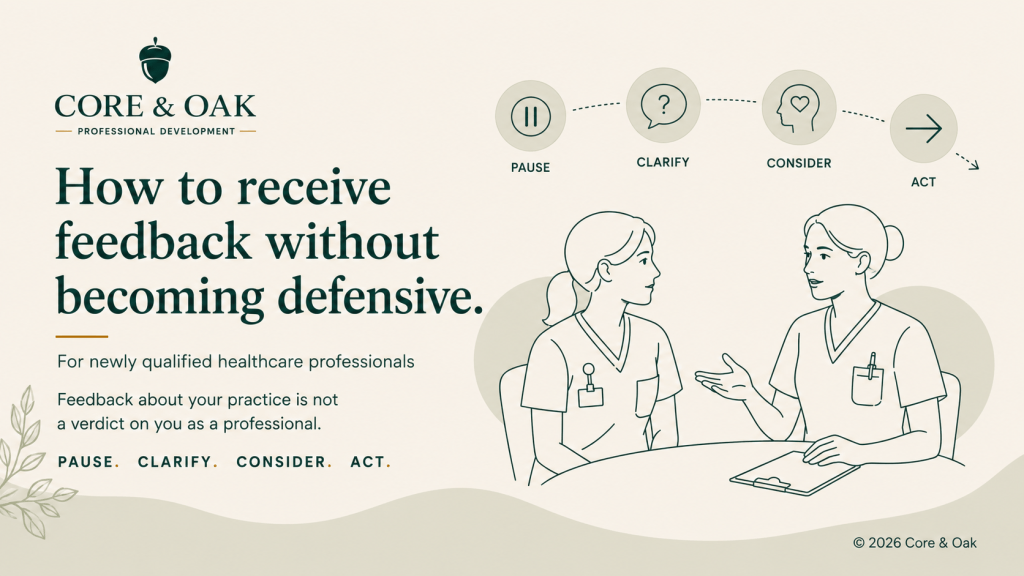
Pause. Clarify. Consider. Act.
You do not have to agree with every piece of feedback you receive.
But it helps to understand it before you decide whether it is useful.
The goal is not:
“How do I prove I was right?”
A better question is:
“What, if anything, can I learn or change from this?”
Professional credibility includes how you respond when your judgement is challenged.
Making your reasoning visible allows other people to question it; learning to respond to that challenge is the next part of professional development.
Why can feedback feel so personal after qualifying?
For much of your training, feedback was closely connected to assessment.
Someone observed what you did.
They judged it against a standard.
Sometimes that judgement affected whether you passed.
It is understandable if some of that feeling follows you into professional practice.
So:
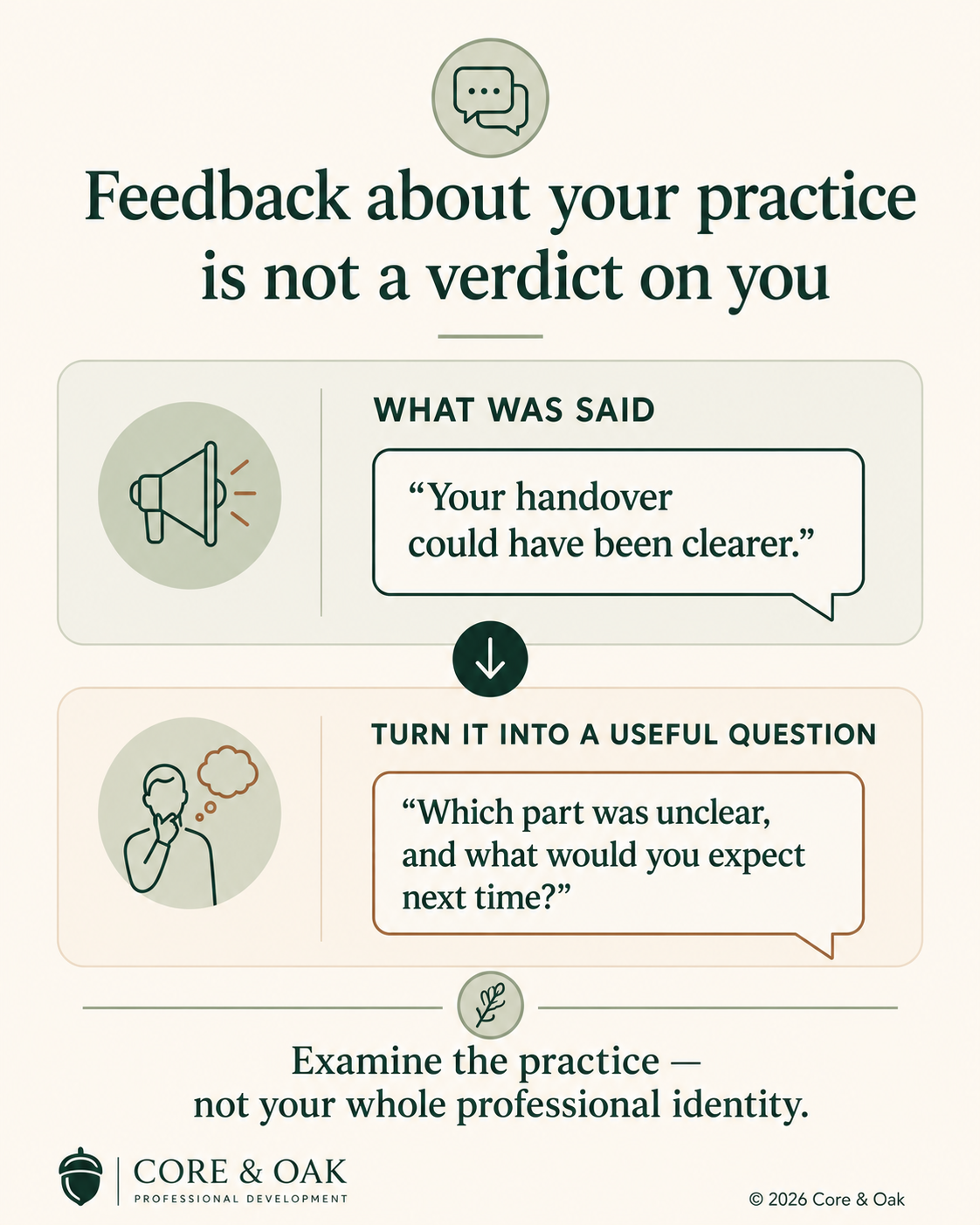
“Your handover could have been clearer.”
can quickly become:
“I’m bad at handover.”
and then:
“They don’t think I’m competent.”
Those are three different statements.
If feedback quickly becomes evidence in your mind that you do not really belong, Why Do New Healthcare Professionals Often Feel Like Imposters? → explores why that reaction can be so strong early in practice.
Useful feedback should help you examine your practice – something you did, decided or communicated.
It should not require you to turn one event into a judgement about your entire professional identity.
That distinction is especially important early in your career, when confidence and professional identity are still developing.
How to stop becoming defensive when you receive feedback
1. Pause before explaining
A defensive response often begins with:
“Yes, but…”
Sometimes there genuinely is important context the other person does not know.
But if you explain it before you have understood their point, it may sound as though your main aim is to prove that you were right.
Try:
“Okay. Can you talk me through what you noticed?”
Or:
“Can you explain which part concerned you?”
That gives you a moment to understand the feedback before deciding whether further explanation is needed.
2. Clarify what they actually mean
Not all feedback is specific enough to be useful.
“You need to be more confident.”
“Your documentation needs to improve.”
“You need to communicate more clearly.”
What exactly should change?
Ask:
“Can you give me an example?”
“Which part would you have approached differently?”
“What would you expect to see next time?”
Specific feedback is easier to act on than a broad judgement.
3. Consider it without automatically accepting it
Feedback is information.
It is not automatically correct simply because it comes from someone more experienced.
Another practitioner may have noticed something important.
They may also have different information, preferences or expectations.
Ask yourself:
- Is there something here I had not considered?
- Is this a pattern I have heard before?
- What part of the feedback is useful?
- Is there relevant context that needs explaining?
- Would I do anything differently next time?
You can take feedback seriously without treating every comment as unquestionable.
4. Decide what happens next
Useful engagement with feedback should eventually lead somewhere.
That might be:
“Next time I’ll state the main concern at the beginning of the handover.”
Or:
“I’ll check the local guidance because I wasn’t aware of that expectation.”
Or even:
“I’ve thought about it and I’d still make the same decision, but I can see that I need to explain my reasoning more clearly.”
The important shift is from defending your identity to evaluating your practice.
A worked example
A newly qualified healthcare professional gives a detailed handover about a patient.
Afterwards, their supervisor says:
“There was a lot of useful information there, but I wasn’t clear what you were actually concerned about.”
Their immediate reaction is:
But I gave you all the information.
They could respond:
“I did explain everything that had happened.”
That may be true.
But it does not help them understand the feedback.
Instead, they ask:
“Can you tell me where you felt the main concern became unclear?”
The supervisor explains that the key change in the patient’s presentation appeared quite late in the handover.
The practitioner thinks about this and responds:
“That makes sense. I was trying to be thorough, but I can see that the important change got buried. Next time I’ll lead with the concern and then give the supporting detail.”
Notice what they have not done.
They have not agreed that the whole handover was poor.
They have not pretended the feedback felt comfortable.
They have identified one useful change.
That is a professional response to feedback.
The hidden curriculum: people notice how you respond when challenged
Early in your career, it is easy to assume professional credibility comes from demonstrating that your decisions were correct.
But colleagues are also learning something else:
What happens when your judgement is questioned?
Can you listen?
Can you ask for clarification?
Can you explain your reasoning without becoming combative?
Can you recognise when somebody else has noticed something useful?
Can you change your practice when appropriate?
These expectations are not always made explicit in day-to-day practice.
But they influence how colleagues experience working with you.
Being open to feedback does not mean becoming passive or unquestioning.
It means being able to examine your practice without treating every challenge as a threat.
What if the feedback feels unfair?
Not all feedback is good feedback.
It can be vague.
Poorly timed.
Inconsistent.
Delivered badly.
Or based on incomplete information.
You are allowed to ask questions.
For example:
“I’d like to understand the specific concern.”
“Can we talk through what you would expect me to do differently?”
You can also take time to reflect, discuss it in supervision or seek another perspective before deciding what you think.
And there is an important boundary here.
Receiving feedback professionally does not mean accepting disrespectful, discriminatory or inappropriate behaviour simply because somebody describes it as feedback.
The aim is thoughtful engagement, not unquestioning compliance.
A useful question after difficult feedback
Instead of asking:
“Was the other person right?”
try:
“What information does this give me?”
Perhaps the feedback identifies something in your practice you genuinely need to develop.
Perhaps it shows that your reasoning was sound but your communication was unclear.
Perhaps it reveals a difference in expectations that needs discussing.
Perhaps, after reflection, you decide you would still make the same professional judgement.
All of those outcomes are possible.
The important thing is that you have considered the feedback rather than simply resisted it.
Reflection
Think about a recent piece of feedback that was difficult to hear.
Ask yourself:
- What was actually said?
- What did I immediately think it meant about me?
- What part of the feedback was useful?
- Is there any context I still need to explain or clarify?
- What, if anything, will I do differently next time?
Feedback becomes professionally useful when you can examine it without allowing one moment to become a verdict on your whole capability.
The Core & Oak Perspective
Being credible does not mean never being corrected.
It does not mean defending every decision.
And it does not mean automatically agreeing with whoever is more senior.
Professional credibility includes being able to stay open when your judgement is challenged.
Sometimes feedback will confirm something you already suspected.
Sometimes it will reveal something you had not noticed.
Sometimes you will decide, after thinking carefully, that you would still make the same decision.
What matters is that you can listen, understand, evaluate and respond.
Being trustworthy does not require you to be beyond challenge.
It requires you to be capable of learning from it.
Want more practical guidance for early professional practice?
Core & Oak explores the parts of healthcare practice that are often expected but rarely explained clearly — professional judgement, communication, uncertainty and the hidden curriculum of becoming a trusted practitioner.
Join the Core & Oak mailing list for new articles and practical resources.
Continue exploring early practice
If explaining your thinking when somebody questions it feels difficult
How to Explain Your Clinical Reasoning Clearly as a Newly Qualified Healthcare Professional →
Learn how to make the reasoning behind your decisions easier for other people to understand.
If feedback quickly makes you question whether you belong
Why Do New Healthcare Professionals Often Feel Like Imposters? →
Explore why increasing responsibility can make capable early-career professionals feel less confident rather than more.
If uncertainty itself is making it difficult to make decisions
Confidence as a Newly Qualified Healthcare Professional: Safe Practice Without Certainty →
Explore how safe professional judgement can still be possible when complete certainty is unavailable.
Want to develop these skills more systematically?
Being able to explain your reasoning is one part of communicating confidently in professional practice.
Professional Communication in Everyday Healthcare takes this further through realistic situations involving uncertainty, escalation, asking for support, difficult conversations, feedback and communicating under pressure.
If you want a structured way to develop these capabilities rather than picking them up only through trial and error, the course provides approximately 10 hours of self-paced CPD designed specifically for early-career healthcare professionals.
About the author
Dr Michael McCluskey is a Chartered Physiotherapist and Senior Fellow of the Higher Education Academy, with experience across clinical practice, healthcare education, programme leadership, assessment and curriculum development.
He founded Core & Oak to create evidence-informed professional development that makes the hidden expectations of healthcare practice clearer.
Professional education disclaimer
This article provides general professional education. It does not provide individual clinical, employment, legal or other professional advice.
Healthcare professionals should follow the professional standards, policies and procedures relevant to their profession, role and organisation.
Further Reading
Hardavella G, Aamli-Gaagnat A, Saad N, Rousalova I, Sreter KB. How to give and receive feedback effectively. Breathe (Sheff). 2017 Dec;13(4):327-333. doi: 10.1183/20734735.009917. PMID: 29209427; PMCID: PMC5709796.
Algiraigri AH. Ten tips for receiving feedback effectively in clinical practice. Med Educ Online. 2014 Jul 28;19:25141. doi: 10.3402/meo.v19.25141. PMID: 25079664; PMCID: PMC4116619.
 Core & Oak