You have assessed the patient.
You have checked the information available to you.
Nothing suggests that immediate escalation is required.
You have explained your reasoning to a colleague, and they agree with your plan.
But you still find yourself thinking:
What if I am wrong?
Building confidence as a newly qualified healthcare professional is not simply about becoming more certain.
One of the harder parts of early practice is learning to make reasonable decisions when some uncertainty remains.
As a student, confidence can feel closely connected to knowing the answer.
You revise. You practise. You are assessed. Someone tells you whether you were right.
Professional practice is different.
Information can be incomplete. A patient’s presentation can change. Several reasonable options may exist. Guidance may inform your decision without telling you exactly what to do.
Sometimes you have to decide what happens next before you can know exactly how the situation will unfold.
That does not make safe practice guesswork.
It means professional confidence has to become something more useful than certainty.
In Brief
Professional confidence in healthcare does not mean being certain that you are right.
Safe practice means using the information available, recognising uncertainty and risk, working within your scope, seeking support when needed and reviewing your decision when new information emerges.
Experienced practitioners still encounter uncertainty.
What develops is their ability to work safely within it.
Why newly qualified healthcare professionals can struggle with confidence
For much of your education, uncertainty had an obvious solution:
Learn more.
If you did not know something, you could revise it.
If you were unsure how to perform a skill, you could practise it.
That is necessary while developing professional knowledge.
But it can quietly create another expectation:
Competent practitioners eventually know enough to stop being uncertain.
They do not.
Healthcare contains incomplete information, changing circumstances, competing priorities and decisions where more than one course of action may be reasonable.
Research with newly qualified doctors suggests that uncertainty during the transition into practice arises not only from clinical situations, but also from unfamiliar responsibilities, professional boundaries and expectations. Support, time and the perceived stakes of the situation can all affect how that uncertainty is experienced.
The difference with experience is often not the disappearance of uncertainty.
It is the ability to ask better questions about it:
- What do I know?
- What don’t I know?
- What matters here?
- What would make this unsafe?
- What needs to happen next?
That is a different kind of confidence.
Sometimes, becoming more aware of this complexity can actually make you feel less confident for a while. One reason imposter feelings can become particularly noticeable in early practice.
Safe practice does not require perfect certainty
Consider a newly qualified health professional assessing a patient who has developed increasing pain.
Nothing in the assessment immediately indicates an emergency, but the presentation is not entirely straightforward.
One response might be:
“I’m probably worrying unnecessarily. I don’t want to look inexperienced.”
Another might be:
“I can’t do anything until I am completely certain what this is.”
Neither is particularly useful.
A better professional question is:
Do I have enough information to make a safe and reasonable decision about what needs to happen next?
The answer might be to continue the assessment.
It might be to check something, gather more information, modify the plan, involve a colleague or escalate for further assessment.
Safe practice can therefore look surprisingly ordinary:
- noticing that something does not fit;
- checking relevant information;
- asking another question;
- recognising the limits of your knowledge or role;
- explaining and documenting your reasoning;
- giving appropriate follow-up or safety-netting advice;
- reviewing the situation when new information emerges; and
- involving someone else when the level of uncertainty or risk requires it.
None of these behaviours requires perfect certainty.
They require professional judgement.
The hidden curriculum: people notice how you reason
Early in your career, it is easy to assume that experienced colleagues are mainly judging how much you know.
Knowledge matters.
But colleagues also gradually learn whether you can recognise uncertainty, identify what matters, understand your limits, explain your reasoning, respond to new information and involve other people appropriately.
They are seeing how you think when the answer is not obvious.
This is part of healthcare’s hidden curriculum.
Your judgement becomes more trustworthy when other people can understand the reasoning behind it.
That is why professional confidence does not need to sound like certainty.
Part of making that judgement visible is knowing when uncertainty means you should involve someone else and being able to ask for help clearly rather than waiting until you feel completely sure.
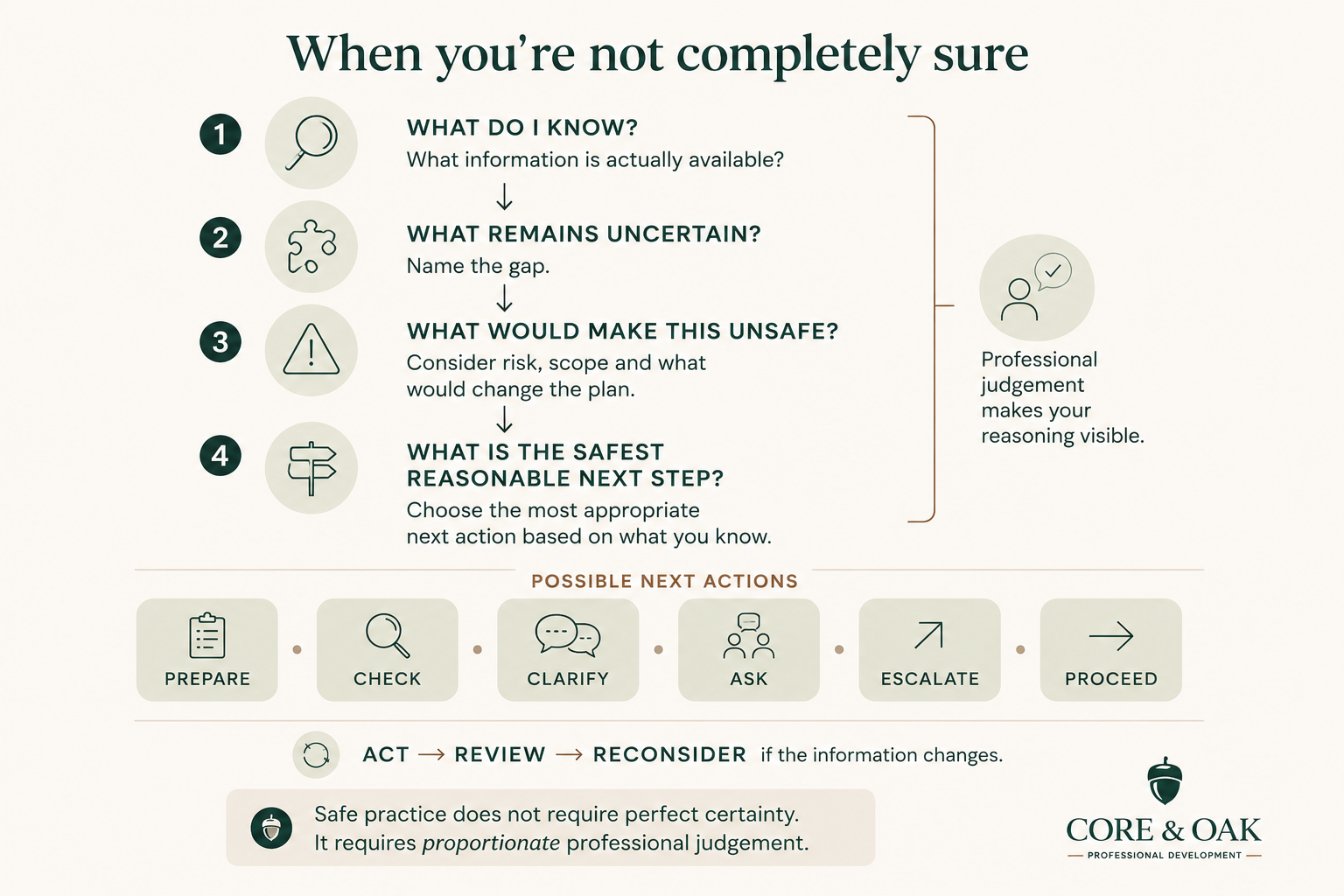
How to make a safe decision when you are uncertain
Instead of asking:
“Am I sure?”
try four more useful questions.
1. What information do I have?
Separate what you actually know from what you fear might be true.
What have you observed?
What has the patient told you?
What information is available from the assessment, record, investigations or wider team?
Start with the information you genuinely have.
2. What remains uncertain?
Name the gap.
Perhaps you need more information.
Perhaps the situation has more than one reasonable explanation.
Perhaps you have reached the boundary of your knowledge or scope.
Perhaps the uncertainty cannot currently be eliminated.
A specific uncertainty is easier to respond to than a general feeling that:
“Something might be wrong.”
3. What would make this unsafe?
Ask:
Is there something that requires urgent action?
Is important information missing?
Would proceeding take me beyond my role or competence?
Is the potential consequence significant enough that I need another opinion?
What change would make me reconsider the plan?
The objective is not to prove that nothing can go wrong.
It is to recognise when uncertainty changes what safe practice requires.
4. What is the safest reasonable next step?
Not the perfect step.
Not the decision that guarantees the outcome.
The safest reasonable next step based on what you know now.
That may be to:
Prepare. Check. Clarify. Ask. Escalate. Reflect.
Sometimes it will also be:
Proceed.
Learning when it is reasonable to proceed despite some remaining uncertainty is part of becoming an autonomous practitioner.
But proceeding despite uncertainty is not the same as ignoring uncertainty.
If you cannot reasonably assess the risk, important information is missing, the decision falls outside your scope, or there is a concern about immediate safety, the appropriate action may be to stop, check, seek advice or escalate.
That distinction is fundamental.
A recent UK systematic review of newly qualified allied health professionals found that graduates were generally well prepared in terms of knowledge, while responsibility and decision-making were among the areas where under-preparedness was more consistently identified.
What professional confidence can sound like
Confidence does not always sound decisive.
Sometimes it sounds like:
“Based on what we know at the moment, I think…”
“The part I’m uncertain about is…”
“There are two reasonable options. My preference is this one because…”
“My concern would increase if…”
“Something doesn’t fit with what I expected, so I’d like another opinion.”
“I don’t know yet. I need to check.”
Those statements do not necessarily weaken professional credibility.
They can make your reasoning clearer.
The confidence comes from being able to locate the uncertainty and decide what it requires, rather than pretending it does not exist.
Want to take stock of your own communication confidence?
Confidence in early practice isn’t all-or-nothing. You may feel comfortable in some situations while still finding others difficult.
Our free Early-Career Communication Confidence Checklist can help you identify what already feels more confident, where you still hesitate, and what you might want to strengthen next.
What if I make the wrong decision?
This fear sits underneath many early-career decisions.
Sometimes you will look back at a decision and realise that, with what you know now, you would choose differently.
That deserves reflection.
But hindsight changes the information available to you.
A poor outcome does not automatically mean that the original decision was unreasonable.
Just as importantly, a good outcome does not automatically mean that the decision-making was sound.
When reviewing a decision, ask:
- What information was available at the time?
- Was relevant risk considered?
- Was the decision within my scope?
- Did I follow relevant guidance?
- Did I involve someone else when I needed to?
- Was my reasoning proportionate to the situation?
Was the decision within my scope?
This moves reflection away from:
“Did everything turn out well?”
towards:
“Was the way I reached and reviewed the decision professionally reasonable?”
Professional judgement is not reserved for situations where the answer is obvious. The Nursing and Midwifery Council, for example, describes nurses, midwives and nursing associates as using professional judgement to make decisions every day, while recognising that difficult circumstances can challenge that judgement.
Defensible does not mean defensive
The word defensible can sound as though healthcare professionals should make decisions primarily to protect themselves.
That is not what it means here.
Defensible practice means that your decision has a professional basis that you can explain.
Compare:
“I thought it would probably be fine.”
with:
“Based on the assessment at that point, I had not identified features requiring immediate escalation. I explained what to monitor, arranged appropriate follow-up and advised what to do if the situation changed.”
The second account does not guarantee a good outcome.
It makes the reasoning visible.
That distinction matters when decisions are reviewed later.
Confidence develops through decisions, not certainty
Professional confidence often grows quietly.
You encounter something unfamiliar.
You assess what you know.
You recognise what you do not know.
You decide whether you need more information, another person’s judgement or a different course of action.
You make a reasonable decision.
Then you see what happens.
The next time you encounter something similar, you have more experience to draw on.
Gradually, the question changes.
From:
“How can I be completely sure?”
to:
“What do I need to know to make this decision safely?”
That is significant professional development.
Reflection
Think about a recent situation in which you wanted more certainty before making a decision.
What did you actually need?
More knowledge?
More information?
Another person’s judgement?
Clarification of your role?
Or reassurance that nothing could go wrong?
Then ask:
What would safe, reasonable and defensible practice have looked like with the information available at the time?
That question is often more useful than asking whether you felt confident.
The Core & Oak Perspective
Professional confidence is not certainty.
It is not bravado.
And it is not the absence of doubt.
It is the growing ability to understand what you know, identify what remains uncertain, recognise risk, make a proportionate decision and remain willing to reconsider it.
Early in your career, you may imagine experienced practitioners have become confident because they finally know enough to stop being uncertain.
Usually, something more interesting has happened.
They have learned which uncertainties matter.
Which require more information.
Which require another person’s involvement.
Which require escalation.
And which can reasonably remain while they proceed.
That is not lowering the standard of safe practice.
It is part of what professional judgement looks like.
Your Next Step
If this article resonated with you, these resources may also help:
FREE RESOURCE
Early-Career Communication Confidence Checklist
A practical self-review tool to help you identify:
- useful priorities for your ongoing professional development
- communication situations that already feel more comfortable
- situations where you still hesitate
- areas you may want to strengthen
RELATED ARTICLE
How much Anxiety is Normal in a Newly Qualified Health Role
Uncertainty is part of professional practice, but sometimes the search for certainty becomes anxiety. Explore how to recognise the difference and decide what the concern is asking you to do.
CONTINUE YOUR DEVELOPMENT
Professional Communication in Everyday Healthcare
If you want to develop these skills more systematically, this self-paced CPD course explores how communication, professional judgement and confidence come together in everyday healthcare practice.
Across approximately 10 hours of learning, you’ll work through realistic situations involving uncertainty, difficult conversations, feedback, escalation and communicating under pressure.
10 hours CPD · Self-paced · Designed for early-career healthcare professionals
Continue exploring early practice
If uncertainty, confidence or professional identity are familiar themes, you may also find these useful:
How to Ask for Help Without Feeling Incompetent
When uncertainty means you need another person’s input, learn how to organise your thinking and ask for support clearly.
Why Do New Healthcare Professionals Often Feel Like Imposters?
Explore why increasing knowledge, responsibility and awareness of complexity can sometimes make you feel less confident rather than more.
About the author
Dr Michael McCluskey is a Chartered Physiotherapist and Senior Fellow of the Higher Education Academy, with experience across clinical practice, healthcare education, programme leadership, assessment and curriculum development.
He founded Core & Oak to create evidence-informed professional development that makes the hidden expectations of healthcare practice clearer.
Professional education disclaimer
This article provides general professional education. It does not provide individual clinical, employment, legal or other professional advice.
Healthcare professionals should work within their scope of practice and follow the policies, escalation procedures and professional standards relevant to their profession, role and organisation.
 Core & Oak