Something has changed.
You are not sure whether it is significant.
Nothing is obviously an emergency, but you are uncomfortable carrying on as though everything is normal.
Then comes the question:
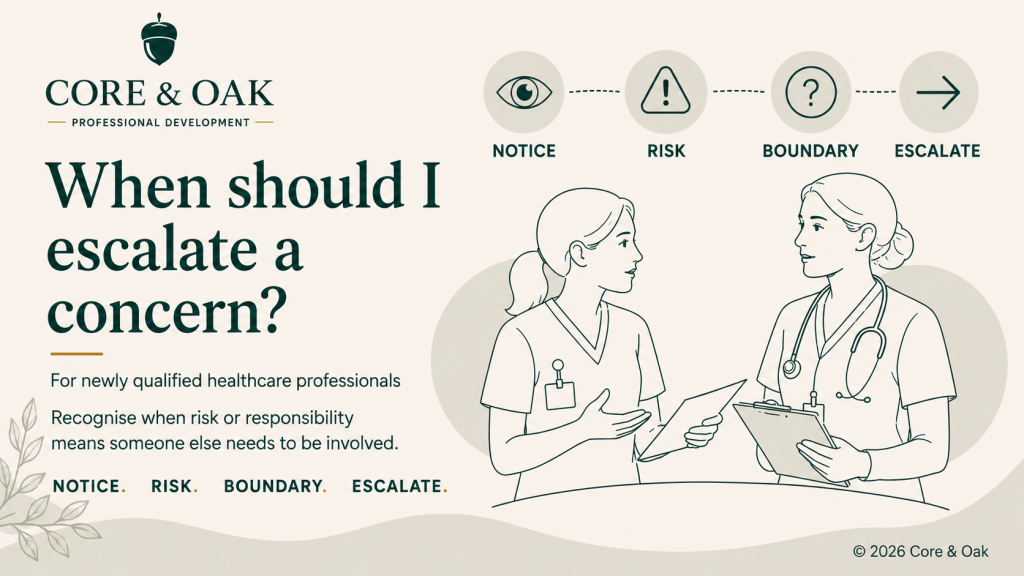
Do I need to escalate this?
Escalation is not simply about how worried you feel. It is a judgement about risk, responsibility and whether the situation now requires somebody else to know, review, decide or act.
In brief
You do not need to know exactly what is wrong before escalating a concern.
Escalation becomes more likely when:
- the person is deteriorating or behaving differently from expected;
- you identify a clinical or professional warning sign that, within your role, requires further review or escalation;
- risk appears to be increasing;
- you cannot safely evaluate what is happening;
- your plan depends on a decision outside your competence or scope of practice;
- continuing could expose someone to avoidable harm;
- you have acted within your role but the concern remains unresolved; or
- a professional, legal or organisational requirement means the concern should be escalated or reported.
What counts as a warning sign differs between professions, settings and patient groups. You still need to act on the clinical, safeguarding and other escalation indicators relevant to your scope and local procedures.
A useful question is:
Does somebody else now need to know, review, decide or act?
Navigating the parts of healthcare practice nobody quite explains?
Core & Oak provides practical articles and resources on professional judgement, communication, uncertainty and career development.
Join the Core & Oak mailing list for new articles and practical resources.
How do I know when to escalate a concern?
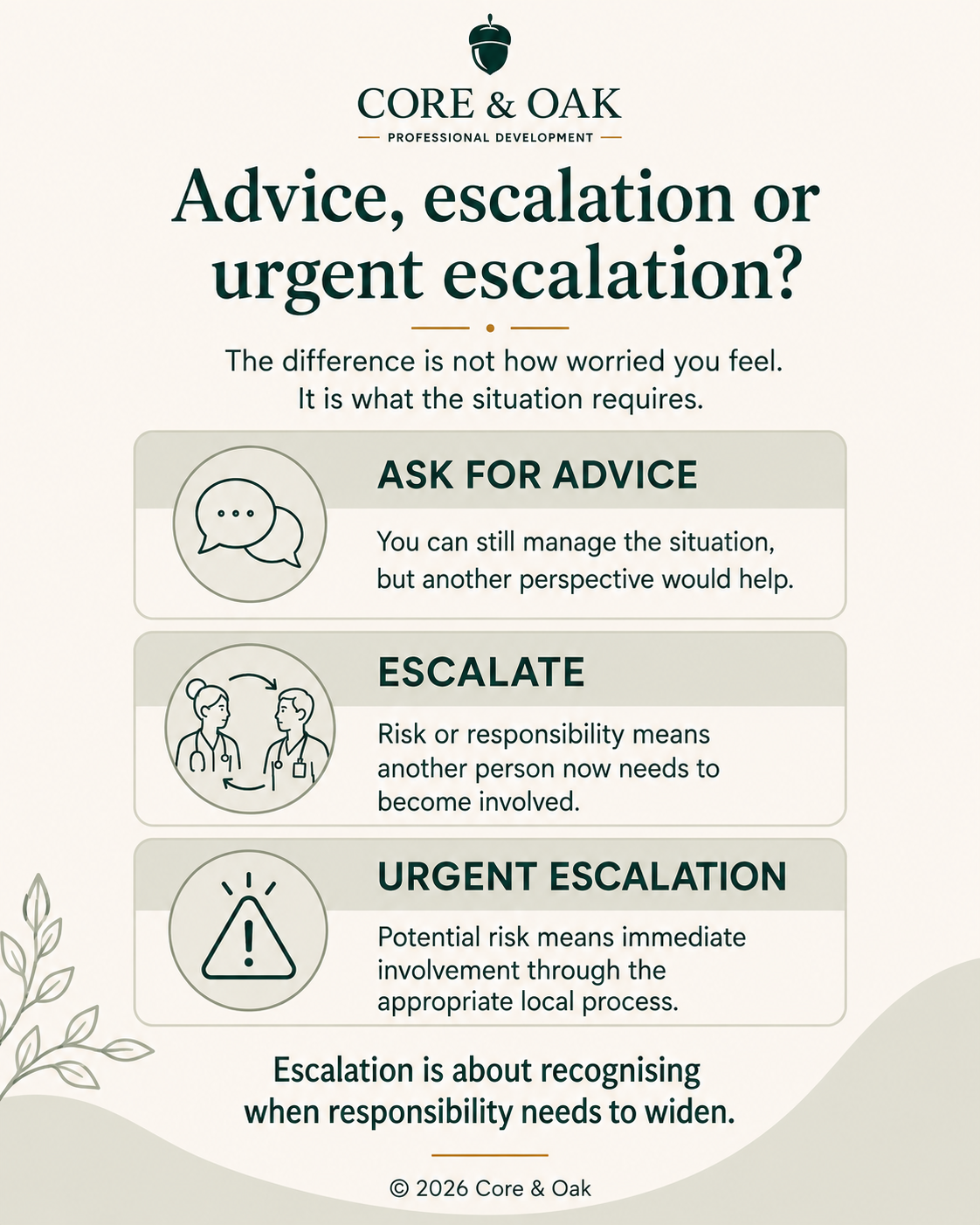
It helps to distinguish three situations.
Asking for advice:
You can still manage the situation within your role, but another perspective would help.
Escalating a concern:
The risk, uncertainty or responsibility means another person now needs to become involved.
Urgent escalation:
The potential risk means somebody else needs to be involved immediately through the appropriate local process.
The difference is not how confident you sound.
It is what the situation requires.
If organising your thoughts before approaching somebody is difficult, How to Ask for Help Without Feeling Incompetent → explores how to make that request clearly.
Do I need to know what is wrong before escalating?
No.
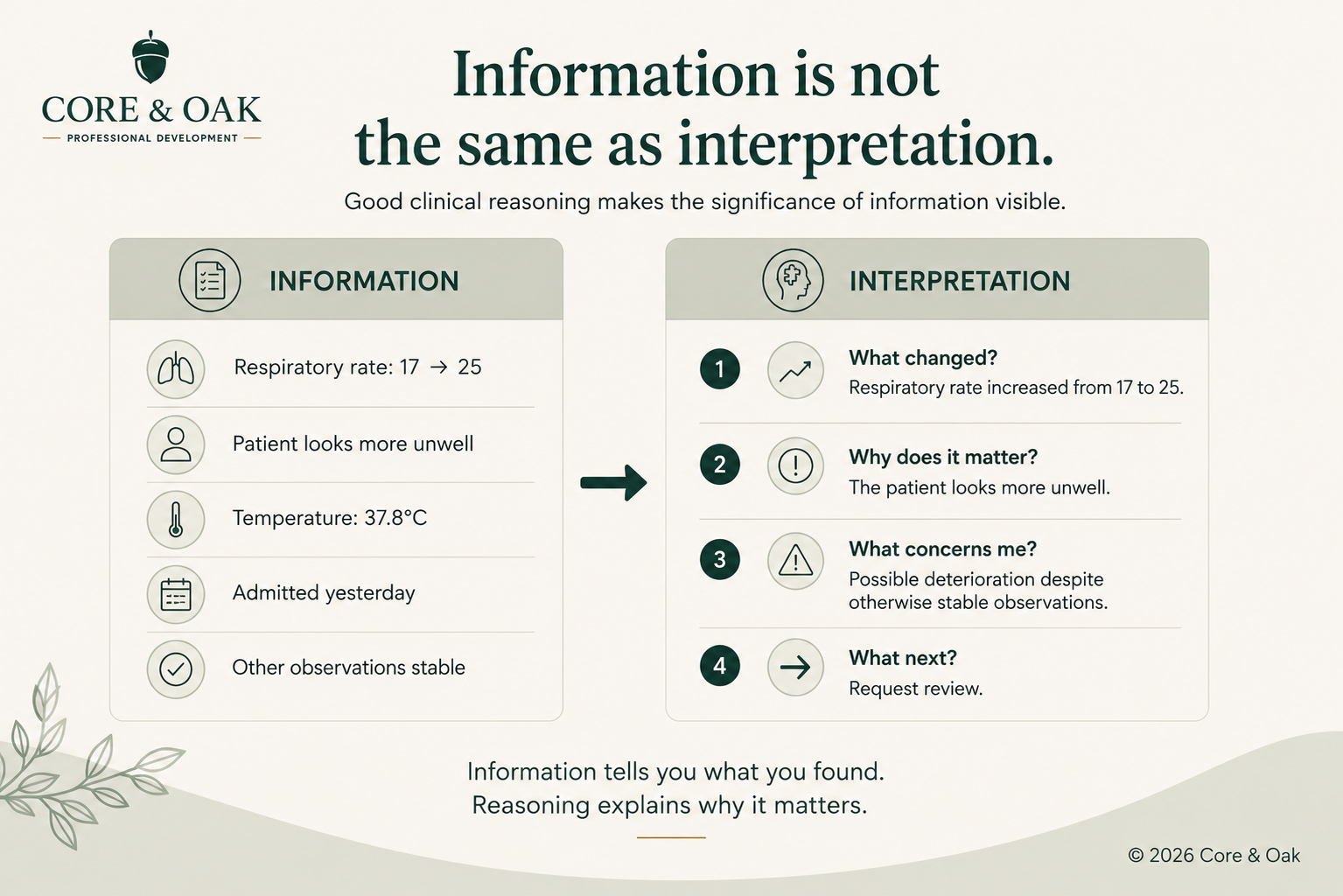
Your responsibility may be to recognise that something has changed, assess the situation appropriately within your role, and decide what that information means for what should happen next.
Imagine a newly qualified physiotherapist mobilising a patient after surgery. Yesterday the patient walked safely with supervision. Today they become unusually breathless after only a short distance and say they feel “not quite right”.
The physiotherapist stops the activity and makes sure the patient is safe.
They then gather the information that is appropriate within their role. Depending on the situation, that might include clarifying the patient’s symptoms, observing their presentation, completing the relevant elements of their usual assessment and reviewing information already available to them.
The assessment may help clarify what is happening.
But it may not provide a diagnosis.
A useful question is:
“Based on what I have observed and assessed, is this sufficiently different or concerning that somebody else now needs to know, review, decide or act?”
If it is, the physiotherapist communicates what has changed, the relevant findings, what they have already done and why they are concerned.
They do not need to establish the underlying diagnosis before escalating.
Their responsibility is to recognise the change, gather appropriate information, respond to immediate risk and recognise when the situation requires input beyond what they can reasonably manage alone.
Where the concern itself requires urgent escalation, gathering additional information should not delay the appropriate response.
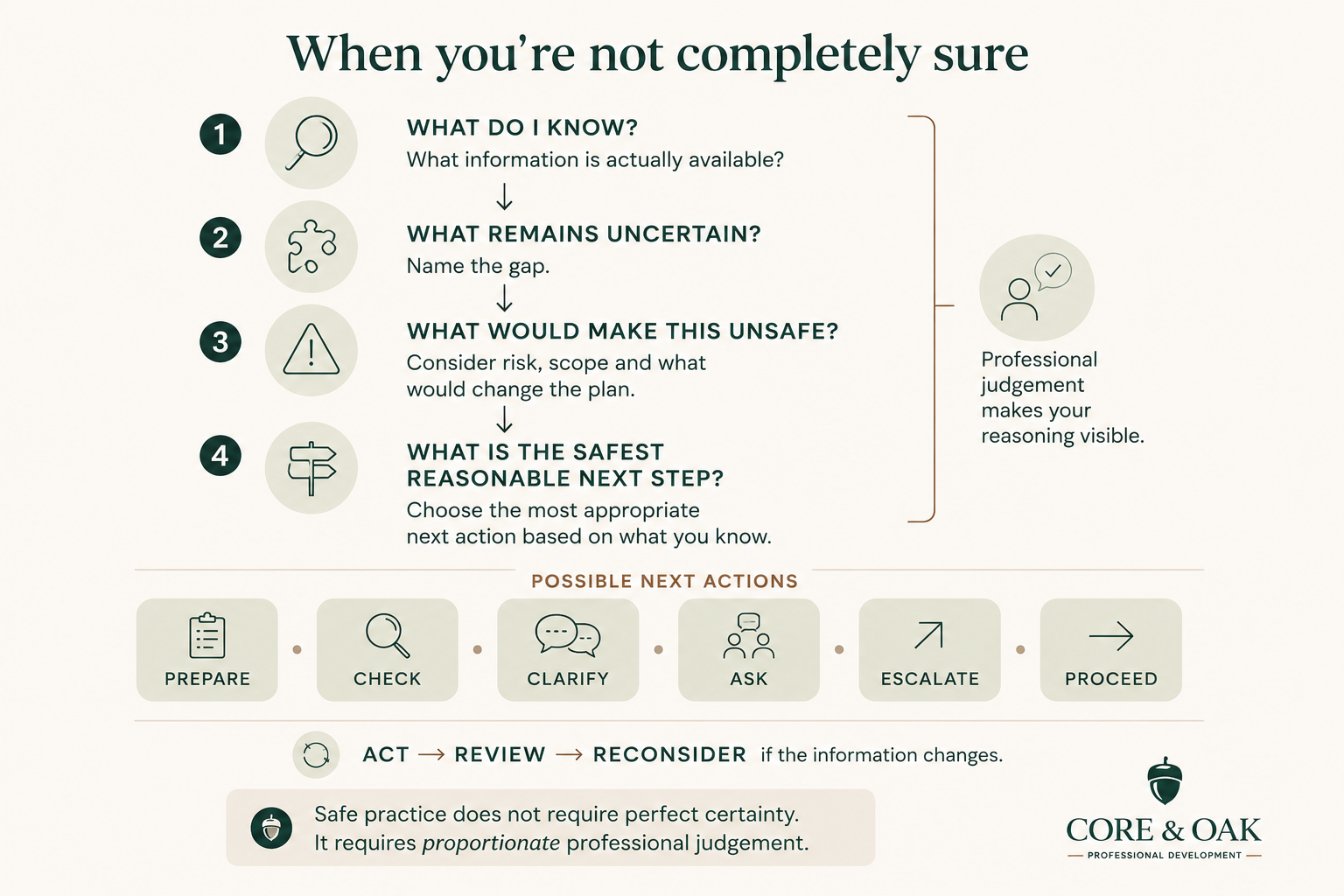
Four questions that can help you decide
1. What has changed?
Has the person’s condition changed?
Has new information emerged?
Has a warning sign appeared?
2. What is the potential risk?
What could happen if nothing changes?
Is risk increasing?
Could delay matter?
Could continuing expose somebody to avoidable harm?
3. Can I safely manage this within my role?
Sometimes a concern remains within your competence and responsibility.
Sometimes you reach a boundary.
You may need expertise you do not have, different authority, or a local pathway may require somebody else to be informed.
4. Does somebody else now need to know, review, decide or act?
Even if you cannot completely explain what is happening, ask whether an appropriate colleague now reasonably needs to be involved.
What should an escalation sound like?
A useful escalation makes the change, concern and requested action clear.
Instead of:
“Can you come and have a look? I’m not really sure.”
you might say:
“Her pain has increased significantly over the last hour and she is much more drowsy than when I assessed her earlier. I’m concerned about the change and I’d like her reviewed.”
You have not claimed certainty.
You have made clear what has changed, why you are concerned and what you need to happen next.
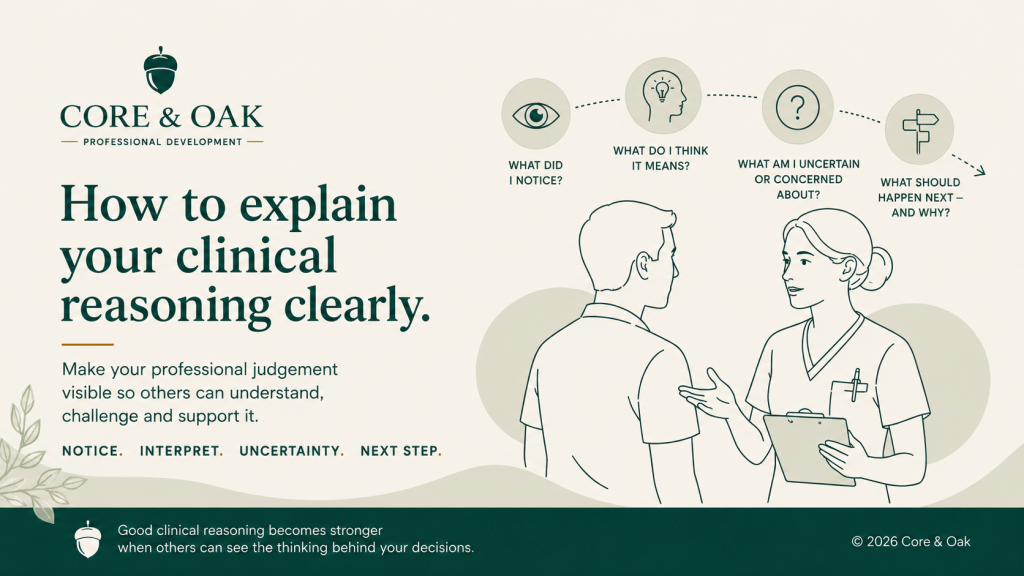
How to Explain Your Clinical Reasoning Clearly as a Newly Qualified Healthcare Professional → explores this skill in more detail.
What if I escalate and it turns out to be nothing?
If nothing serious is identified, it can be tempting to conclude:
“I overreacted.”
Instead ask:
Was escalation reasonable based on the information and potential risk available at the time?
A reassuring outcome does not automatically mean escalation was unnecessary.
The purpose of escalation is not to predict the future perfectly.
It is to respond proportionately to what you know at the time.
What if a senior colleague dismisses my concern?
Telling one person does not necessarily mean your professional responsibility has ended.
If you continue to believe there is a material safety concern, the situation is deteriorating or the response seems disproportionate, follow the escalation procedures appropriate to your role, profession and organisation.
That does not mean approaching people until somebody agrees with you.
It means remaining appropriately responsible for a concern you reasonably believe still requires attention.
The hidden curriculum: knowing when responsibility needs to widen
Newly qualified healthcare professionals are expected to become increasingly autonomous.
But autonomy does not mean dealing with everything alone.
Sometimes you can assess, decide and proceed.
Sometimes you need advice.
Sometimes another professional needs to review the situation.
And sometimes risk means responsibility must widen quickly.
Part of autonomy is recognising when independence is no longer the safest response.
The Core & Oak perspective
Appropriate escalation is not the opposite of independence.
It is one of the ways you demonstrate that you understand your responsibility.
You recognised that something had changed.
You considered the potential risk.
You understood the limits of what you could safely manage.
And you recognised when somebody else needed to become involved.
That is not handing responsibility away.
It is knowing when responsibility needs to widen.
And that is professional judgement in action.
FREE RESOURCE
What to Say When You’re Unsure
Recognising that somebody else needs to become involved is only part of escalation. You also need to communicate the concern clearly.
Our free practical guide includes example language to help early-career healthcare professionals:
- raise a concern with a senior colleague;
- explain what they have already noticed or considered;
- ask clearly for the support or review they need; and
- communicate uncertainty without pretending to have an answer they do not have.
Continue exploring early practice
If you know you need somebody else’s input but hesitate to ask
How to Ask for Help Without Feeling Incompetent →
Learn how to organise your thinking, explain what you already know and ask for support clearly.
If the difficult part is explaining why you are concerned
How to Explain Your Clinical Reasoning Clearly as a Newly Qualified Healthcare Professional →
Explore how to make the connection between what you have noticed, what you think it means and what you believe should happen next.
If uncertainty is making it difficult to decide whether to act
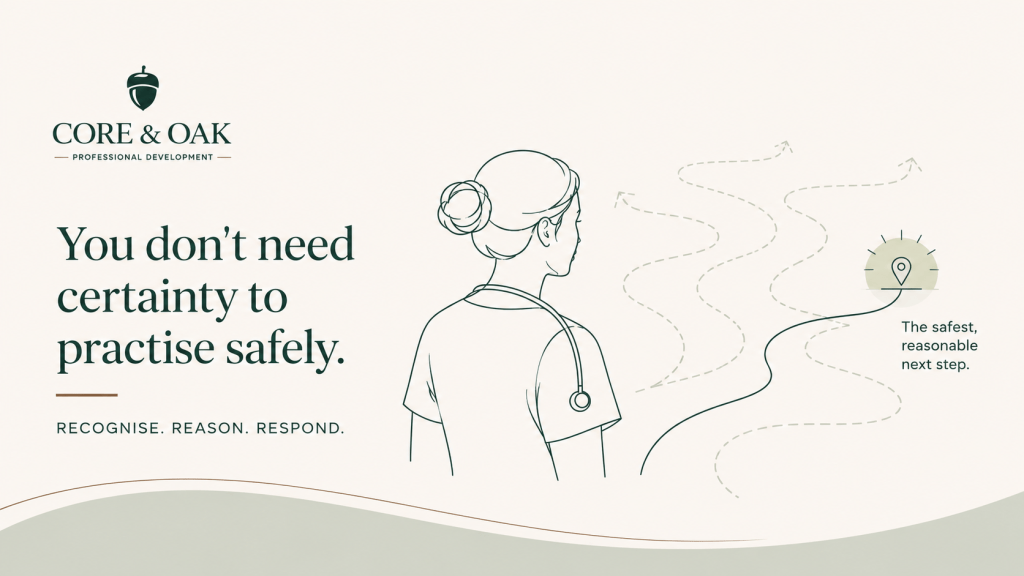
Confidence as a Newly Qualified Healthcare Professional: Safe Practice Without Certainty →
Explore how safe and defensible decisions can still be made when complete certainty is unavailable.
About the author
Dr Michael McCluskey is a Chartered Physiotherapist and Senior Fellow of the Higher Education Academy, with experience across clinical practice, healthcare education, programme leadership, assessment and curriculum development.
He founded Core & Oak to create evidence-informed professional development that makes the hidden expectations of healthcare practice clearer.
Professional education disclaimer
This article provides general professional education. It does not provide individual clinical, employment, legal or other professional advice.
Healthcare professionals should work within their scope of practice and follow the professional standards, clinical guidance, escalation procedures, policies and processes relevant to their profession, role, patient group and organisation.
Where an urgent or emergency concern exists, practitioners should follow the appropriate local escalation or emergency procedure.
Further reading
Health and Care Professions Council. Standards of conduct, performance and ethics. Effective from 1 September 2024.
Particularly relevant to recognising limits, managing risk, communicating appropriately and raising concerns within professional practice.
Includes expectations relating to preserving safety, recognising and responding to risk, raising concerns and practising within competence.
General Medical Council. Good medical practice.
Includes professional expectations relating to patient safety, working within competence, responding to risks and communicating concerns appropriately.
 Core & Oak