You realise something has gone wrong.
Perhaps you documented something in the wrong record.
You gave somebody information that was not correct.
You forgot to complete something you had intended to do.
Or you made a decision that, looking back, you think should have been different.
Your stomach drops.
Then the thoughts arrive:
How serious is this?
Do I need to tell someone?
What are they going to think of me?
Could I get into trouble?
Does this mean I am not safe to practise?
When you are newly qualified, making a mistake can feel like confirmation of everything you were already worried about.
But before you decide what the mistake says about you, there is a more important professional question:
What needs to happen now?
In brief
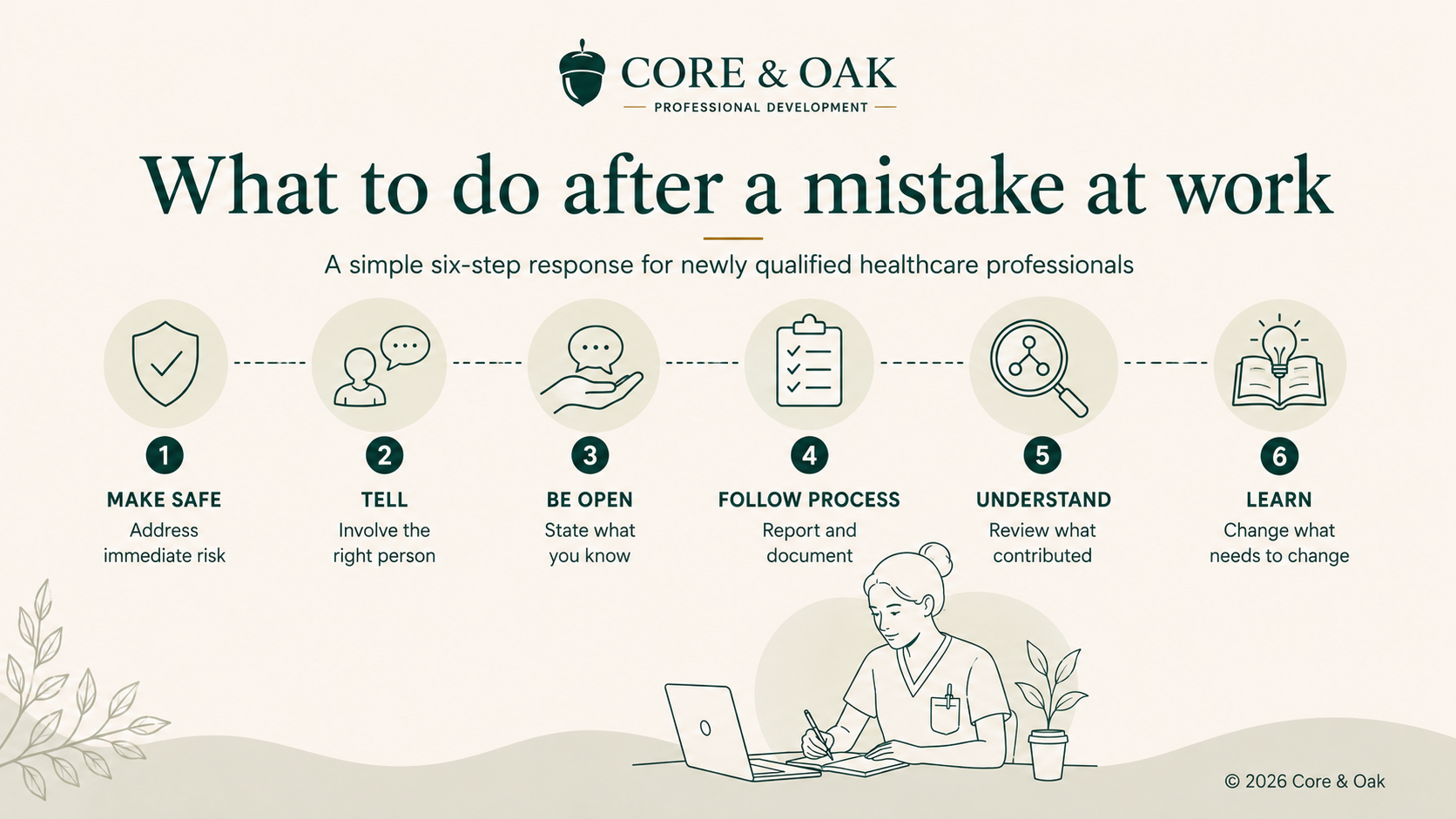
If you think you have made a mistake at work:
- make the situation as safe as you reasonably can;
- tell the appropriate person;
- be open and factual about what you know has happened;
- follow the reporting, documentation and candour processes relevant to your role and organisation;
- understand what contributed; and
- identify what, if anything, needs to change.
Professional standards across healthcare place clear expectations on practitioners to respond appropriately when things go wrong.
The mistake matters.
How you respond to it matters too.
I made a mistake at work in healthcare — what should I do first?
Start with safety.
Ask:
Is anybody currently at risk?
Can something be corrected before the situation becomes worse?
Does somebody else need to know now?
Imagine you realise that you have given a patient incorrect information about what they should do after discharge.
The first priority is not deciding whether this means you are a bad practitioner.
It is working out what needs to happen to correct the situation and reduce any potential harm.
Depending on the circumstances, that might involve informing an appropriate colleague, arranging further review, correcting information through the appropriate process or following an established safety procedure.
What you need to do will depend on your profession, role and organisation.
But the principle is straightforward:
Deal with immediate risk before analysing why the mistake happened.
This is reflected across professional standards. For example, the HCPC requires registrants to be open, honest and candid when something has gone wrong, including taking action to correct a mistake where possible and following relevant organisational procedures. The NMC similarly expects practitioners to act where actual or potential harm has occurred and to escalate appropriately.
Should I tell my manager or senior colleague if I make a mistake?
If the mistake could affect somebody’s care, safety or rights, or you are uncertain about its significance, involve the appropriate person rather than trying to decide alone what should happen next.
One understandable early-career reaction is:
“I need to work out how serious this is before I tell anyone.”
But you may not yet have enough information or experience to judge every possible consequence yourself.
That is not a reason to stay silent.
It may be exactly why somebody else needs to become involved.
You might say:
“I’ve realised that I gave Mrs Jones the wrong information about her follow-up. I want to make sure we correct it appropriately. Can I talk you through what happened?”
Or:
“I’ve noticed that I entered this assessment in the wrong patient record. I haven’t tried to correct it yet because I want to make sure I follow the right process.”
These statements do not minimise what happened.
They also do not claim certainty about its significance.
They make the situation visible so it can be managed appropriately.
Be open about what you know without guessing what you don’t
Fear can push people in two directions.
One is catastrophising:
“I’ve caused a disaster.”
The other is minimising:
“It probably doesn’t matter.”
Neither helps you establish what actually happened.
Start with the facts.
What did you do?
What were you trying to do?
What happened afterwards?
What do you know?
What remains uncertain?
What action has already been taken?
Professional candour does not require you to immediately know exactly why something happened.
You may know:
“I gave the patient incorrect information.”
without yet knowing:
“This happened entirely because I was careless.”
The circumstances may need further review.
There may be something in your own practice that needs to change. There may also be contributing factors involving communication, workload, systems, equipment or processes.
Be honest about what you know.
Do not conceal important information.
But do not invent certainty about causes that have not yet been established.
What if the mistake did not cause any harm?
Not every mistake results in harm.
An error may be noticed and corrected before anything happens. Something may almost go wrong but be caught in time. Equally, a patient may experience a poor outcome even though the original professional decision was reasonable based on the information available.
These situations are not identical.
That distinction matters because:
No harm does not necessarily mean nothing needs to happen.
Depending on the circumstances, an error or near miss may still need to be discussed, documented or reported because it provides important information about safety.
Equally, a poor outcome does not automatically prove that somebody made a mistake.
What matters is understanding what happened and following the processes relevant to your situation.
What if I only realise later that I made a mistake?
You may not recognise an error immediately.
Perhaps new information becomes available later.
Perhaps you think about the situation after your shift and realise that something needs reviewing.
Perhaps a colleague asks a question that makes you notice something you had missed.
The principle does not change because time has passed.
Ask:
Could somebody still be affected?
Can anything still be corrected?
Does somebody now need to know?
Do not assume that because the original moment has passed there is nothing useful you can do.
If you are unsure, involve the appropriate colleague or follow the relevant organisational process.
Could I get into trouble for making a mistake at work?
There can be professional or organisational consequences when something goes wrong.
But a mistake does not automatically mean disciplinary action, regulatory referral or the end of your career.
The response will depend on what happened and the circumstances around it.
Factors may include the seriousness of the incident, actual or potential harm, the practitioner’s actions, whether relevant procedures were followed, and how the situation was responded to afterwards.
Your immediate responsibility is therefore not to predict the eventual consequence.
It is to respond professionally.
That means addressing safety, being honest about what happened, involving the appropriate people and following the relevant process.
Trying to hide, alter or minimise important information can create a much more serious professional issue than the original mistake.
Accountability is not the same as assuming the worst possible outcome.
It means allowing what happened to be considered properly.
The hidden curriculum: people notice what you do when things go wrong
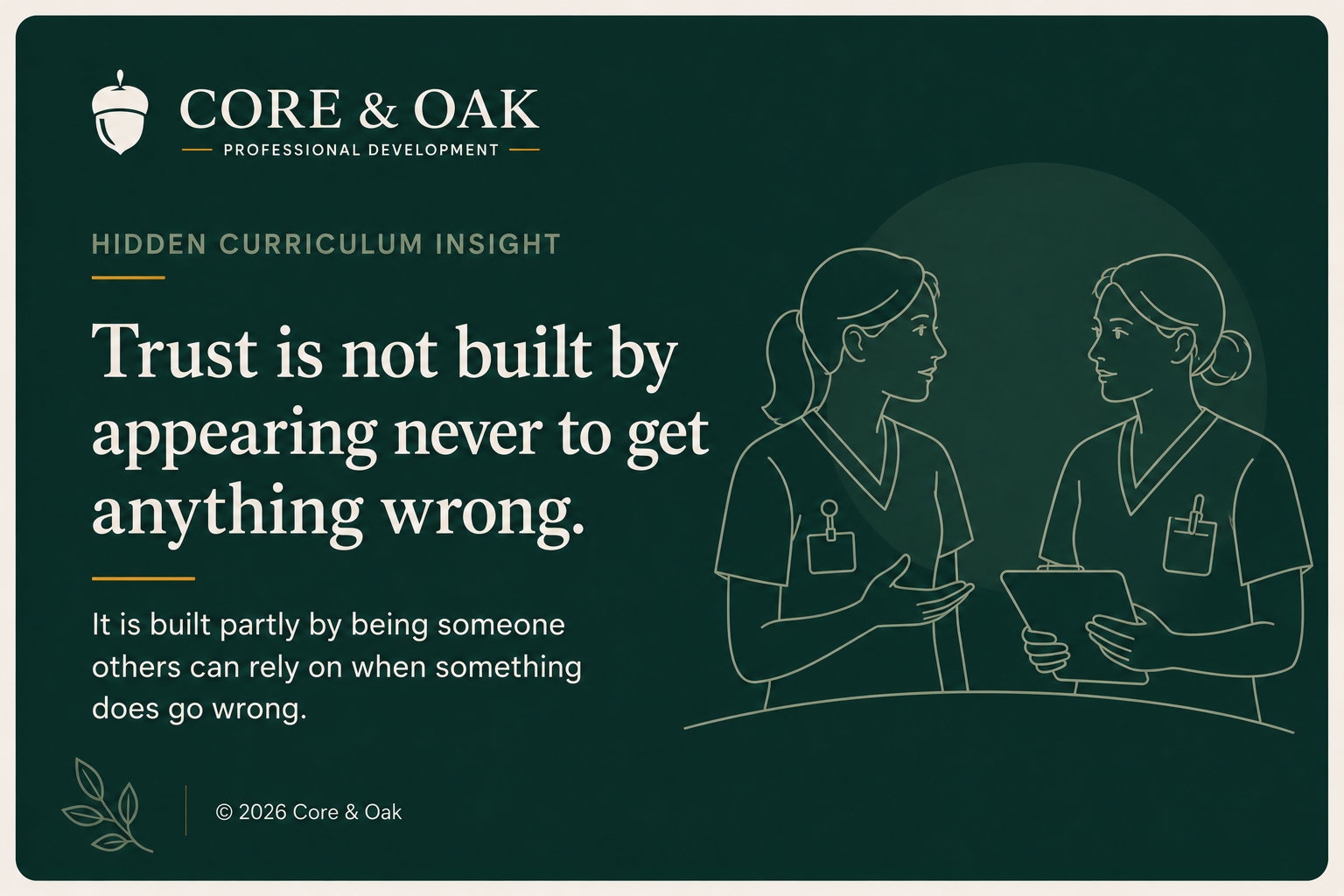
When you are newly qualified, you may assume professional credibility depends on never making mistakes.
Safe practice obviously matters.
But professional trust is also shaped by what colleagues see when something becomes difficult.
Do you recognise the issue?
Do you speak up?
Can you explain what happened clearly?
Can you accept appropriate challenge?
Do you follow through on what needs to happen?
Can you change your practice when something genuinely needs to change?
These expectations are not always taught explicitly.
They are part of healthcare’s hidden curriculum.
New graduates are being informally assessed not simply on whether they complete tasks, but on judgement, communication, insight, professional behaviour and whether they are safe and reliable to work alongside.
That is why this matters:
Take responsibility without assuming everything was your fault
Once the immediate situation has been dealt with, the question changes.
From:
“What do I need to do now?”
to:
“What can we understand from what happened?”
There are two unhelpful extremes.
The first is:
“I made the mistake, so everything that happened was entirely my fault.”
The second is:
“The system contributed, so I have no responsibility.”
Professional learning usually requires a more careful position.
You can take responsibility for your own actions while also examining the circumstances in which those actions occurred.
Modern patient-safety approaches recognise that incidents can be influenced by interactions between people, processes, workload, communication, technology and the wider working environment.
Ask:
What was my contribution?
What else influenced what happened?
What was within my control?
What needs to change in my practice?
Does something in the team, process or system also need to change?
Suppose a practitioner selects the wrong option in an electronic system.
Their own checking process may need to change.
But review might also reveal that the options look very similar, staff are frequently interrupted at that point in the workflow or other colleagues have encountered the same problem.
Recognising those factors does not remove individual accountability.
It helps identify more effectively what needs to improve.
How should I reflect on a mistake?
Reflection becomes useful once the immediate situation has been appropriately managed.
A question such as:
“How could I have been so stupid?”
does not tell you very much about how to improve practice.
Instead, ask:
- What actually happened?
- What was I trying to achieve?
- What information was available to me at the time?
- What did I notice?
- What did I miss?
- What influenced my action or decision?
- Were workload, communication, interruptions or processes relevant?
- What did I do appropriately once I recognised the issue?
- What would I do differently next time?
- Does anything beyond my own practice need to change?
The purpose of reflection is not to produce self-criticism.
Nor is the aim simply to demonstrate regret.
Useful reflection should help you understand the event well enough to identify what needs to be retained, developed or changed.
This is another part of healthcare’s hidden curriculum.
Reflection demonstrates professional credibility when it shows insight, learning and meaningful action rather than simply describing how an experience made you feel.
A worked example
A newly qualified occupational therapist completes an assessment and records it electronically.
Later that afternoon, they realise that they entered the assessment in the record of another patient with a similar surname.
Their first reaction is panic.
They are tempted simply to correct the problem quickly and move on.
Instead, they stop and seek advice about the appropriate process.
They inform the relevant senior colleague and explain exactly what they have noticed.
They then follow the organisation’s procedures for correcting the clinical record and reporting the incident.
Later, they consider what contributed.
They recognise that they had several patient records open at the same time and had not completed their usual identity check before entering the information.
They change their own practice.
The organisation may also consider whether anything about the electronic system or local workflow could reduce the likelihood of similar errors.
The useful professional learning is not:
“I must never make another mistake.”
That is not a realistic safety strategy.
It is:
“When I recognised something had gone wrong, I acted openly and appropriately. I understand more about how it happened, and something has now changed because of it.”
What if the mistake has badly affected my confidence?
Even after the practical issue has been dealt with, you may continue thinking about what happened.
You might replay it after work, worry about what colleagues think or hesitate when you next encounter something similar.
That reaction can be significant.
But one incident does not, by itself, tell you whether you are a safe or unsafe practitioner.
A more useful question is:
What does my response to this incident show, and what do I need to learn from it?
Did you recognise the problem?
Did you act appropriately once you recognised it?
Were you open?
Did you engage with the review?
Did something useful change afterwards?
Those questions give you more meaningful information about your professional development than repeatedly replaying the mistake.
If an incident is causing significant or persistent distress, seek appropriate support through the routes available to you, such as a supervisor, manager, preceptor, occupational health service, professional body or healthcare professional.
The Core & Oak perspective
Being a trustworthy healthcare professional does not require a flawless career.
It does require honesty about your practice.
When something goes wrong:
Make the situation safe.
Tell the appropriate person.
Be open about what you know.
Follow the relevant process.
Understand what contributed.
Learn proportionately.
Early in your career, you may imagine that experienced practitioners are trusted because they have reached a point where they no longer make mistakes.
That is not the whole story.
Professional trust is also built through what happens afterwards.
Through being willing to say:
“Something has gone wrong.”
“This is what I know.”
“This is what I have done about it.”
“This is what I have learned.”
A mistake deserves an appropriate professional response.
It does not need to become your entire professional identity.
Your next step
If you are unsure whether something now needs escalating
When Should I Escalate a Concern as a Newly Qualified Healthcare Professional? →
Explore how to decide when another person needs to know, review, decide or act.
If somebody has challenged how you handled the situation
How to Receive Feedback Without Becoming Defensive as a Newly Qualified Healthcare Professional →
Learn how to understand and evaluate difficult feedback without treating it as a verdict on your whole professional capability.
If you need to explain your decision-making clearly
How to Explain Your Clinical Reasoning Clearly as a Newly Qualified Healthcare Professional →
Explore how to make the connection between what you noticed, what you thought it meant and what you decided to do.
Want more practical guidance for early professional practice?
Core & Oak explores the parts of healthcare practice that are often expected but rarely explained clearly such as professional judgement, communication, uncertainty, accountability and career development.
Join the Core & Oak mailing list for new articles and practical resources.
About the author
Dr Michael McCluskey is a Chartered Physiotherapist and Senior Fellow of the Higher Education Academy, with experience across clinical practice, healthcare education, programme leadership, assessment and curriculum development.
He founded Core & Oak to create evidence-informed professional development that makes the hidden expectations of healthcare practice clearer.
Professional education disclaimer
This article provides general professional education. It does not provide individual clinical, employment, legal or other professional advice.
Healthcare professionals should work within their scope of practice and follow the professional standards, incident-reporting procedures, duty-of-candour requirements, policies and processes relevant to their profession, role, organisation and jurisdiction.
Where there is an immediate patient-safety concern, practitioners should follow the appropriate local escalation or emergency process.
Further reading
Health and Care Professions Council. (2024). Standards of conduct, performance and ethics. Effective from 1 September 2024.
Nursing and Midwifery Council. The Code: Professional standards of practice and behaviour for nurses, midwives and nursing associates.
General Medical Council and Nursing and Midwifery Council. Openness and honesty when things go wrong: the professional duty of candour.
NHS England. Patient Safety Incident Response Framework.
Reason J. Human error: models and management BMJ 2000; 320 :768 doi:10.1136/bmj.320.7237.768
Sirriyeh, R., Lawton, R., Gardner, P. and Armitage, G. (2010). Coping with medical error: a systematic review of papers to assess the effects of involvement in medical errors on healthcare professionals’ psychological well-being. Quality and Safety in Health Care, 19(6), e43.
 Core & Oak