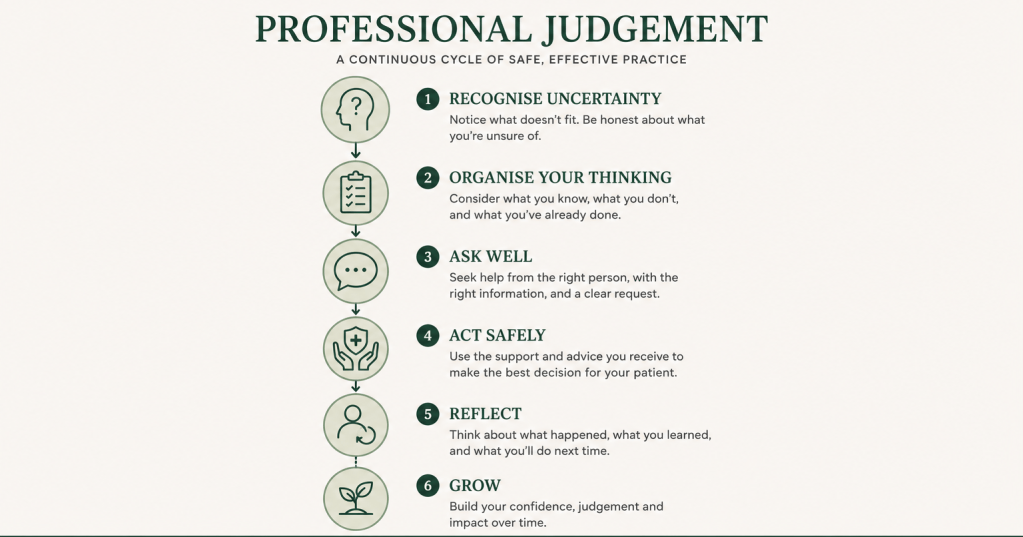
It is not usually the biggest decisions that make newly qualified healthcare professionals hesitate.
It is the smaller moments.
The patient whose observations do not quite fit the clinical picture. The wound that looks slightly different from yesterday. The medication calculation you have checked twice but still want someone else to review.
You rehearse the question before approaching your supervisor.
Everyone seems busy. You do not want to interrupt. You wonder whether you should already know the answer.
Ten minutes later, you are still worrying.
Eventually, you ask.
Your supervisor listens, asks two questions and says:
“I’m glad you came to ask.”
The conversation lasts less than a minute.
So why did asking feel harder than the question itself?
In Brief
Most newly qualified healthcare professionals do not ask too many questions.
More often, they ask them too late.
The goal is not to avoid asking for help. The goal is to ask well.
Experienced clinicians do not expect you to know everything.
They expect you to recognise uncertainty, organise your thinking and seek appropriate support when it matters.
Those are all signs of developing professional judgement.
Why does asking for help feel so difficult?
Many newly qualified healthcare professionals assume they are being judged on what they know.
That is understandable.
Only a few months ago, your knowledge was being assessed through written exams, practical assessments and placement sign-offs. It can feel as though that judgement continues after qualification.
In reality, something begins to change.
Experienced clinicians are rarely expecting you to know everything.
Instead, they notice how you respond when you are uncertain.
Can you recognise that something doesn’t feel right?
Can you explain why you are concerned?
Can you seek help before uncertainty becomes risk?
These behaviours often matter more than having the perfect answer.
This is one of healthcare’s hidden expectations.
Many of the qualities that help practitioners become trusted are never taught explicitly, but they are noticed every day.
Asking for help is part of professional judgement
One of the biggest misconceptions in early practice is that asking for help signals a lack of competence.
Most experienced clinicians see it differently.
They are usually far more concerned about delayed escalation, misplaced confidence or silence than they are about thoughtful questions.
Knowing when to involve someone else is part of safe practice.
In fact, recognising your own uncertainty is often one of the clearest signs that your professional judgement is developing.
That is a very different standard from “knowing everything”.
A simple way to organise your thinking before asking for help
When you need support, the ASK Framework can help you organise your thinking before approaching a colleague.
- Assess – What do I know? What am I uncertain about? Is anyone at immediate risk?
- Structure – Briefly explain the situation, your concern, what you have already done and the decision you need help with.
- Know your request – Be specific about the support you need.
Rather than asking:
“Can you help?”
try:
“Could you help me decide whether this patient needs reviewing now?”
A worked example
A newly qualified nurse noticed that a patient’s respiratory rate was gradually increasing.
The patient appeared well, and the observations had not triggered an emergency response. Even so, something did not feel right.
She asked a senior nurse to review the patient.
The patient was later diagnosed with sepsis.
The feedback she remembered was simple:
“You did exactly the right thing.”
She was not praised for knowing the diagnosis.
She was praised for recognising uncertainty and acting on it.
Reflection
Think about the last time you hesitated before asking for help.
- What stopped you?
- Were you worried about interrupting?
- Were you worried about looking inexperienced?
- Were you worried about being wrong?
- Or were you trying to protect your professional identity?
Recognising these patterns is often the first step towards changing them.
The Core & Oak Perspective
The safest practitioners are not the ones who ask the fewest questions.
They are the ones who recognise when a question needs asking.
Over time, you will still ask for help. The questions will simply become more focused, more organised and more confident.
Healthcare has never expected you to know everything.
It expects you to recognise uncertainty, respond appropriately and seek support when it matters.
Your Next step
If this article resonated with you, you might also find these resources helpful:
Why New Healthcare Professionals Feel Like Imposters
Understand why increasing awareness often makes you feel less confident—and why that’s a normal part of becoming a safe practitioner.
What to Say When You’re Unsure:
A practical guide to framing uncertainty, asking for support and escalating concerns without undermining your professional credibility.
Continue developing your communication
Professional Communication in Everyday Healthcare is an online, self-paced 10 Hour CPD course which explores how communication operates in everyday healthcare practice and introduces practical approaches that help clinicians communicate clearly under pressure.
About the author
Dr Michael McCluskey is a Chartered Physiotherapist and Senior Fellow of the Higher Education Academy, with experience across clinical practice, healthcare education, programme leadership, assessment and curriculum development.
He founded Core & Oak to create evidence-informed professional development that makes the hidden expectations of healthcare practice clearer.
Learn more about Michael and Core & Oak
Professional education disclaimer
This article provides general professional education. It does not provide individual clinical, employment, legal, psychological or occupational-health advice.
Healthcare professionals should work within their scope of practice and follow the policies, escalation procedures and professional standards relevant to their role and organisation.
Anyone experiencing significant or persistent distress should seek appropriate individual support.
Editorial and evidence standards
Core & Oak content is developed using the following principles:
- content is written or reviewed by a suitably qualified professional;
- professional and regulatory sources are prioritised where relevant;
- research evidence is interpreted cautiously and within its limitations;
- practical guidance is distinguished from individual clinical advice;
- uncertainty, contextual variation and system pressures are acknowledged;
- articles are periodically reviewed and updated;
- commercial links are included only where the resource is relevant to the reader’s identified need.
 Core & Oak