You have completed the course, passed the assessments and met the requirements for professional registration.
Other people now introduce you as the nurse, physiotherapist, pharmacist, occupational therapist, radiographer, doctor or healthcare professional responsible for someone’s care
Yet part of you may still be waiting for someone to discover that you do not really know what you are doing.
You may compare yourself with experienced colleagues who appear calm and certain. You may replay small mistakes after a shift, hesitate before asking for help or worry that needing reassurance means you are not ready for the role.
You might think:
- Everyone else seems more confident than me.
- I should know this by now.
- What if someone asks me something I cannot answer?
- What if I make a mistake and people realise I am not capable?
These thoughts can feel deeply personal.
In reality, they often arise from a difficult but normal professional transition.
You are no longer a student working within an educational safety net. You are now a registered professional expected to make, communicate and justify real decisions—often before you feel fully established in the role.
That gap between being qualified and feeling like a credible practitioner is where imposter feelings often grow.
In brief
Newly qualified healthcare professionals often feel like imposters because their responsibility increases faster than their confidence and experience.
Qualification confirms that you have met the standard required to enter professional practice. It does not mean that you will immediately feel comfortable in every situation or know how to respond to every unfamiliar presentation.
Feeling uncertain does not automatically mean that you are unsafe.
What matters is how you recognise risk, work within your limits, communicate concerns and seek appropriate support.
Why imposter feelings are common after qualifying
Responsibility changes quickly
As a student, your work usually takes place within a visible structure of supervision, assessment and educational support.
After qualification, supervision still exists, but it often feels less obvious. You may be expected to assess, plan, act, review, document and escalate while managing a real workload.
You are simultaneously:
- accountable for your own actions;
- still developing professionally;
- learning unfamiliar systems;
- managing the needs of real patients;
- being observed by colleagues;
- working out what is expected but not always stated.
This creates a difficult tension.
You are expected to act as an autonomous practitioner, but you do not yet have the pattern recognition, contextual knowledge or confidence that develops through repeated experience.
It can therefore feel as though you should know more than you do.
The reality is simpler:
Registration confirms readiness to begin professional practice. It does not mark the end of professional development.
Healthcare is full of uncertainty
Education can make practice appear more predictable than it is.
Cases have learning outcomes. Assessments have marking criteria. Simulated scenarios are designed to test particular capabilities.
Real practice is less tidy.
Patients may present atypically. Information may be incomplete. Guidelines may not fit the person in front of you. Different professionals may interpret the same situation differently. Staffing, time and resources may also influence what is possible.
A newly qualified practitioner may interpret this uncertainty as personal failure:
“I do not know exactly what to do, so I must not be competent.”
A more experienced practitioner is likely to ask:
“What do I know, what is the immediate risk, what information is missing and who else needs to be involved?”
The difference is not always knowledge.
It is often a more developed way of managing uncertainty.
You compare your internal doubts with other people’s external performance
You hear your own uncertainty in full detail.
You usually see only the visible behaviour of your colleagues.
You see a senior nurse give a clear instruction, but not the years of experience behind it. You hear a consultant summarise a case confidently, but not every possibility they considered. You watch an experienced physiotherapist adapt an assessment, but not the many previous patients who helped them recognise the pattern.
This creates an unfair comparison:
your developing internal reasoning against someone else’s polished external performance.
Experienced practitioners are not necessarily certain.
They may simply be better at identifying priorities, organising uncertainty and communicating a clear plan.
The hidden expectations are rarely explained
Healthcare professionals are not judged only on whether they can complete clinical tasks.
Colleagues also form impressions based on:
- how you communicate when uncertain;
- whether you recognise your limits;
- how you respond to feedback;
- whether you escalate appropriately;
- how reliably you follow through;
- whether you are safe to work alongside.
Much of this assessment is informal and unspoken.
This is part of the hidden curriculum of healthcare practice.
When these expectations are not made explicit, newly qualified professionals may assume that credibility means appearing knowledgeable and confident at all times.
It does not.
Credibility is more often built through:
- visible judgement;
- clear communication;
- appropriate humility;
- consistent professional behaviour.
Does uncertainty mean you are not competent?
No.
Feeling uncertain may indicate that you recognise the complexity of the situation.
A new practitioner can feel anxious and still behave safely. An experienced practitioner can feel confident and still make a poor decision.
The better question is not:
“Do I feel confident?”
It is:
“Am I recognising risk, using the available information, working within my limits and seeking support when I need it?”
Confidence and competence are related, but they are not the same.
Professional standards do not require you to know everything. They require you to work within your scope, recognise limitations and respond responsibly when you need advice or support.
Asking for help is therefore not evidence that you are an imposter.
It is part of safe professional practice.
What people often misunderstand
Asking for help does not automatically reduce credibility
New practitioners sometimes delay asking for support because they fear being judged.
In practice, senior colleagues usually need to know:
- what has happened;
- what you have observed;
- what you have already considered or done;
- what concerns you;
- what support or decision you need.
There is a difference between saying:
“I do not know what to do.”
and saying:
“I am concerned about this change. I have checked the available information and I would like you to review it with me.”
The second response does not pretend certainty.
It demonstrates that you have engaged with the situation.
One mistake does not prove that you should never have qualified
Mistakes, omissions and imperfect decisions occur throughout professional life.
What matters is how you respond.
This includes:
- addressing any immediate risk;
- being open about what happened
- seeking appropriate support;
- learning from the situation;
- identifying whether wider systems also need to change.
One correction, one difficult shift or one piece of critical feedback does not invalidate your qualification.
It gives you information about what you need to develop next.
Confidence should not be the first goal
Trying to feel confident at all times can encourage people to hide uncertainty or avoid asking questions.
A safer early goal is to become increasingly able to:
- recognise what matters;
- explain your reasoning;
- act within your limits;
- escalate appropriately;
- learn from experience.
Confidence often follows repeated evidence that you can manage difficult situations safely.
What safe practice looks like when you lack confidence
Safe early-career practice does not mean performing like someone with ten years of experience.
It means behaving appropriately for your current level of competence and responsibility.
A safe and credible newly qualified practitioner:
- notices and responds to risk;
- works within their scope;
- communicates concerns clearly;
- asks focused questions;
- documents important decisions;
- responds openly to feedback;
- becomes more independent over time.
The aim is not to remove every feeling of uncertainty.
The aim is to become increasingly capable of managing uncertainty safely.
At this career stage, trust matters more than brilliance.
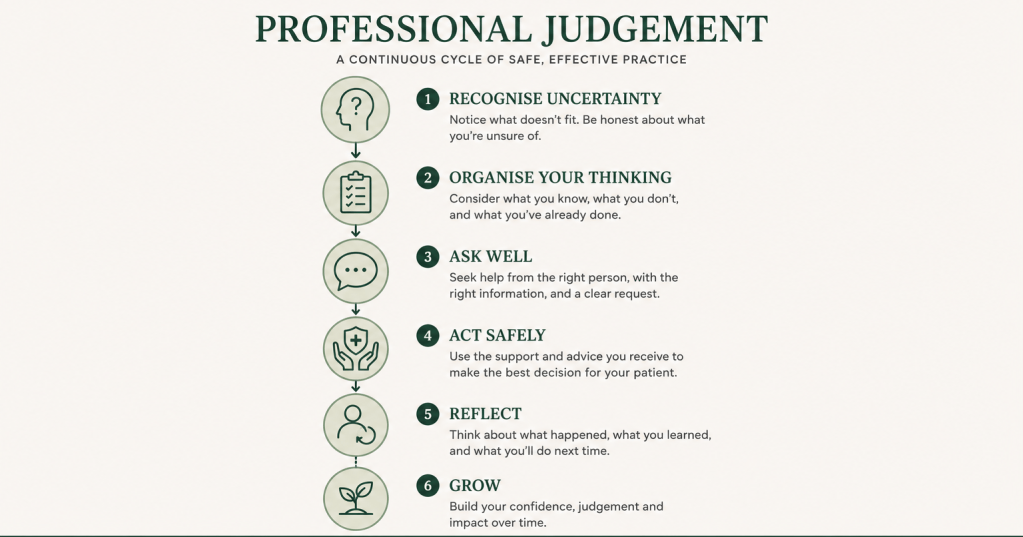
A practical framework: NOTICE, FRAME, ACT
When imposter feelings arise, use three steps.
NOTICE what is happening
Separate the feeling from the professional situation.
Ask yourself:
- What am I uncertain about?
- Is there an immediate patient-safety concern?
- Is this outside my competence, or simply unfamiliar?
- What information do I already have?
- What information is missing?
Instead of thinking:
“I have no idea what I am doing.”
Try to identify the specific issue:
“I am uncertain whether this change is clinically significant, and I need to review the information and discuss it with a senior colleague.”
The second statement is more precise and easier to act upon.
FRAME the uncertainty professionally
Organise what you need to communicate.
A useful structure is:
- Situation: What is happening?
- Evidence: What have you observed?
- Reasoning: What do you think may be happening?
- Risk: What concerns you?
- Request: What support or decision do you need?
For example:
“Mr Ahmed’s pain has increased over the last hour and he looks more pale than earlier. His blood pressure has also fallen compared with the previous reading. I am concerned this may represent more than expected postoperative pain. I have repeated his observations and would like you to review him now.”
This does not claim certainty.
It demonstrates attention, reasoning, risk recognition and appropriate escalation.
ACT at the right level
Choose a response proportionate to the situation.
This may involve:
- continuing with an appropriate plan;
- checking a policy or guideline;
- asking a focused question;
- requesting supervision;
- escalating urgently;
- documenting the decision;
- arranging review;
- identifying a learning need afterwards.
Once the situation is safe, reflect briefly:
- What did I notice correctly?
- What information changed the decision?
- What would I recognise earlier next time?
- What should I revise, practise or discuss?
The purpose is not to prove that you were inadequate.
It is to turn experience into better future judgement.
Worked example
A newly qualified physiotherapist is assessing a patient on an acute medical ward.
The patient has been referred for a mobility assessment before discharge. During the assessment, the patient says they feel light-headed. The physiotherapist also notices that the patient appears less alert than they did at the beginning of the session.
The physiotherapist thinks:
“I should know whether this is serious. An experienced physiotherapist would know what to do. Perhaps I am overreacting.”
An unsafe response would be to minimise the concern and continue because they do not want to appear inexperienced.
An excessively dependent response would be to ask a senior colleague to take over without first identifying or communicating the concern.
A safe and credible response would be to:
- stop the assessment;
- ensure the patient is safe;
- clarify what has changed;
- seek the appropriate clinical review;
- communicate the concern clearly.
The physiotherapist might say:
“Mr Lewis became light-headed while standing and appears less alert than at the start of the assessment. I have stopped the session and returned him safely to the chair. I am concerned about the change in his presentation and do not think it is appropriate to continue until he has been reviewed.”
The physiotherapist does not need to diagnose the cause.
Their responsibility is to notice the change, stop safely, communicate clearly and involve the appropriate colleague.
That is not evidence of being an imposter.
It is professional judgement in action.
Reflection and application
Think about a recent situation in which you felt less capable than other people believed you were.
Ask yourself:
- What was the specific professional uncertainty?
- What did safe practice require from me at that moment?
- What evidence suggests that I am developing?
Evidence of development may include something you noticed, a question you asked, feedback you used, a concern you escalated or a decision you explained more clearly afterwards.
You do not need to feel like an expert to behave like a responsible professional.
When you may need additional support
Imposter feelings should not be used to dismiss significant distress or difficult workplace conditions.
Seek appropriate support if anxiety or self-doubt is:
- affecting your sleep or life outside work;
- making it difficult to attend work;
- interfering with concentration or decision-making;
- linked to bullying, discrimination or an unsafe workplace;
- becoming difficult to manage alone.
Support may be available from a trusted supervisor, line manager, preceptorship lead, professional body, occupational health service, trade union representative or healthcare professional.
It is also important to recognise that not every confidence problem belongs to the individual.
Poor induction, inconsistent supervision, excessive workload, incivility and psychologically unsafe team cultures can intensify imposter feelings.
Healthcare organisations have a responsibility to create environments where staff can ask questions, discuss mistakes and raise concerns safely.
The Core & Oak perspective
Healthcare rewards more than the ability to complete tasks.
Over time, practitioners become trusted because they can:
- think through uncertainty;
- communicate what matters;
- justify decisions;
- recognise limitations;
- reflect on experience;
- contribute safely within a team.
You are not expected to arrive fully formed on the day you qualify.
You are expected to practise responsibly while continuing to develop.
The goal is not to manufacture confidence.
It is to develop judgement that can be made visible, communicated clearly and defended professionally.
That is how confidence becomes grounded in practice rather than performance.
Your next step
Clear communication is one of the main ways healthcare professionals make their judgement visible.
Download the free Core & Oak guide:
What to Say When You’re Unsure:
A practical guide to framing uncertainty, asking for support and escalating concerns without undermining your professional credibility.
or
Early-Career Communication Confidence Checklist:
This checklist is a practical self-review tool to help you identify what already feels more confident, what still feels challenging and what you may want to strengthen next.
Continue developing your communication
Professional Communication in Everyday Healthcare is an online, self-paced 10 Hour CPD course which explores how communication operates in everyday healthcare practice and introduces practical approaches that help clinicians communicate clearly under pressure.
About the author
Dr Michael McCluskey is a Chartered Physiotherapist and Senior Fellow of the Higher Education Academy, with experience across clinical practice, healthcare education, programme leadership, assessment and curriculum development.
He founded Core & Oak to create evidence-informed professional development that makes the hidden expectations of healthcare practice clearer.
Learn more about Michael and Core & Oak
Professional education disclaimer
This article provides general professional education. It does not provide individual clinical, employment, legal, psychological or occupational-health advice.
Healthcare professionals should work within their scope of practice and follow the policies, escalation procedures and professional standards relevant to their role and organisation.
Anyone experiencing significant or persistent distress should seek appropriate individual support.
Editorial and evidence standards
Core & Oak content is developed using the following principles:
- content is written or reviewed by a suitably qualified professional;
- professional and regulatory sources are prioritised where relevant;
- research evidence is interpreted cautiously and within its limitations;
- practical guidance is distinguished from individual clinical advice;
- uncertainty, contextual variation and system pressures are acknowledged;
- articles are periodically reviewed and updated;
- commercial links are included only where the resource is relevant to the reader’s identified need.
Sources and further reading
Health and Care Professions Council. (2024) Standards of conduct, performance and ethics. Effective from 1 September 2024. London:HCPC.
General Medical Council (2023) Good medical practice. Effective 30 Jan 2024. London: GMC. Available at: https://www.gmc-uk.org/professional-standards/good-medical-practice-2024. %5B1, 2, 3, 4, 5]
Nursing and Midwifery Council. (2018). The code: Professional standards of practice and behaviour for nurses, midwives and nursing associates. NMC. https://www.nmc.org.uk/standards/code/ %5B1]
Salari N, Hashemian SH, Hosseinian-Far A, Fallahi A, Heidarian P, Rasoulpoor S, Mohammadi M. Global prevalence of imposter syndrome in health service providers: a systematic review and meta-analysis. BMC Psychol. 2025 May 28;13(1):571. doi: 10.1186/s40359-025-02898-4. PMID: 40437646; PMCID: PMC12117965.
Chua SM, Tan IYK, Thummachai ME, et al. Impostor syndrome, associated factors and impact on well-being across medical undergraduates and postgraduate medical professionals: a scoping review. BMJ Open 2025;15:e097858. doi: 10.1136/bmjopen-2024-097858

 Core & Oak