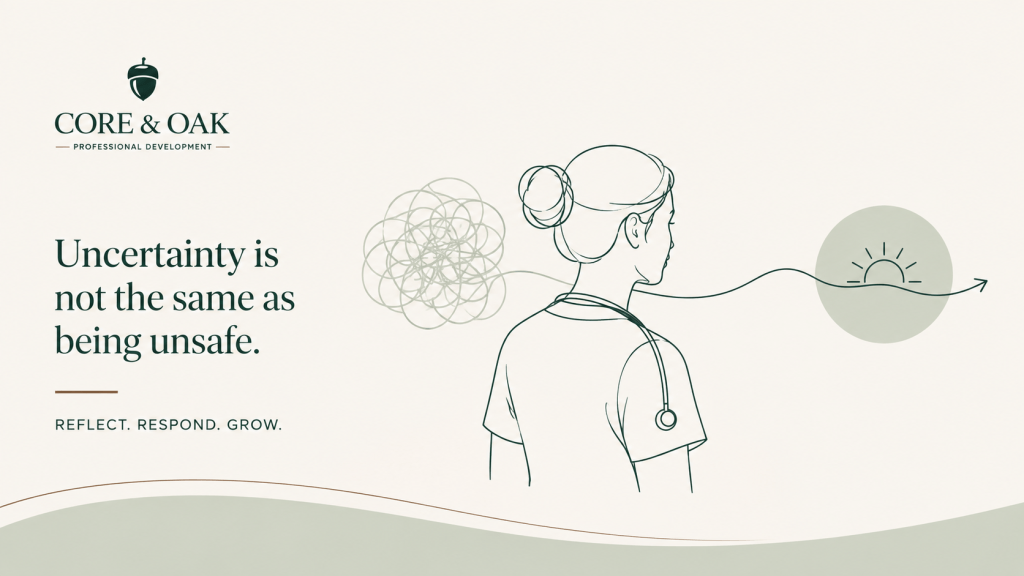
You finish your shift and start thinking about one of your patients.
Did I explain that clearly enough?
Should I have asked someone to review them earlier?
Did I miss something?
You replay the conversation on the drive home.
Nothing obviously went wrong. You followed the plan. You asked for help when you needed it.
But the thought is still there.
What if I got something wrong?
For many newly qualified healthcare professionals, this can be one of the more unsettling parts of starting work.
You expected the responsibility.
You may not have expected how much you would think about it afterwards.
In Brief
Some anxiety is common when you begin a healthcare role.
You are working with more independently, with greater responsibility, making decisions in less predictable situations and becoming more aware of what you do not yet know.
The important question is not simply:
“Am I anxious?”
A more useful question is:
“What is this anxiety leading me to do?”
Concern that prompts you to prepare, check, ask, reflect or escalate can be part of developing professional judgement.
Anxiety that increasingly leads to avoidance, repeated reassurance-seeking, persistent rumination or difficulty functioning deserves a different response.
And sometimes the problem is not simply confidence. Workload, inadequate support, unclear expectations or workplace culture can make an already demanding transition considerably harder.
Is it normal to feel anxious in a newly qualified healthcare role?
It can be.
Starting professional practice involves a significant change in responsibility.
As a student, you were learning within systems of highly structured supervision. Decisions could be discussed, checked and often shared with someone more experienced before, during and after interactions.
After qualification, that relationship begins to change.
You are increasingly expected to notice what matters, make judgements, communicate concerns and recognise when someone else needs to be involved.
Your knowledge has not suddenly disappeared.
What has changed is your relationship with responsibility.
That distinction matters.
Feeling uncertain does not automatically mean that you are unprepared for practice. Sometimes it means you are beginning to appreciate the complexity of the work more fully.
A patient rarely presents like an examination question.
Information can be incomplete. Priorities compete. People respond unpredictably. Decisions have to be made despite uncertainty.
Becoming comfortable with that takes time.
Why can confidence actually fall after qualifying?
This can feel particularly confusing.
You spent years developing your knowledge and skills. You qualified. You secured a professional role.
Surely you should feel more confident?
Not necessarily.
As your experience grows, so can your awareness of complexity.
You begin noticing exceptions.
You see that the same intervention does not work for everyone.
You become more aware of risk, competing priorities and the consequences of decisions.
You start recognising situations where there isn’t one obviously correct answer.
Paradoxically, greater awareness can temporarily feel like less confidence.
This overlaps with something we explored in Why New Healthcare Professionals Feel Like Imposters: the transition into professional practice can increase your awareness of what you do not yet know.
That is not necessarily evidence that you are becoming less capable.
It can be evidence that your thinking is becoming more sophisticated.
What are experienced colleagues actually expecting from you?
This is one of the less visible parts of becoming a healthcare professional.
New practitioners can assume that credibility comes from appearing confident and knowing the answer.
Experienced colleagues are often looking for something different.
They notice whether you:
- recognise when something does not fit;
- work within your scope of practice;
- explain your reasoning;
- ask appropriate questions;
- escalate concerns when necessary;
- respond constructively to feedback; and
- learn from experience.
In other words, they are not simply observing what you know.
They are observing what you do when you don’t know.
That is part of healthcare’s hidden curriculum.
Professional credibility develops not from eliminating uncertainty, but from responding to it safely and appropriately.
This is also why professional confidence does not require complete certainty. Confidence can develop through becoming clearer about how you reason, recognise your limits and decide what to do next.
When can anxiety actually be useful?
Anxiety is uncomfortable, so our instinct is often to treat it as something that needs to disappear.
But a degree of concern can sometimes serve a useful function.
Imagine you are about to complete an unfamiliar procedure.
You feel slightly nervous.
That feeling prompts you to review the guidance, prepare carefully and ask an experienced colleague to confirm something before you begin.
The anxiety has led to useful professional behaviour.
Or you are reviewing a patient and something about the presentation does not quite fit.
You cannot immediately explain why.
That discomfort makes you stop, reassess and seek another opinion.
Again, the feeling has prompted action.
The aim is not to become anxious in order to practise safely.
It is to recognise that feeling concerned and practising competently can exist at the same time.
The useful question becomes:
What is this concern asking me to do?
Perhaps you need to:
Prepare.
Check.
Clarify.
Ask.
Escalate.
Reflect.
Once you identify the appropriate professional action, the feeling itself becomes less important than what you do next.
Know what you need to do, but unsure how to say it?
Sometimes concern tells you that you need to ask, clarify or escalate. Finding the right words can still be difficult, particularly when you’re newly qualified.
Our free What to Say When You’re Unsure guide provides practical example language for asking for support, communicating uncertainty and escalating concerns clearly.
When might anxiety be getting in the way?
There is an important difference between anxiety that occasionally accompanies responsibility and anxiety that begins to dominate your working life.
Consider the pattern rather than one difficult shift.
Are you increasingly:
- checking the same thing repeatedly despite having appropriate confirmation?
- avoiding situations primarily because you fear making a mistake?
- seeking reassurance but finding that it only helps briefly?
- replaying routine interactions for long periods after work?
- struggling to switch off even when nothing specific has gone wrong?
- finding that anxiety is interfering with your ability to work, rest or function outside work?
These experiences do not tell us, by themselves, what is causing the problem.
But they are worth taking seriously.
The appropriate response may be different from simply telling yourself to “be more confident”.
Depending on the circumstances, that might involve talking with a supervisor or manager, using occupational health or employee support services, or seeking appropriate individual healthcare support.
Recognising that you need support is not a failure of professional resilience.
It is another form of responding appropriately to what you notice.
Not all workplace anxiety is an individual problem
This distinction is particularly important.
It is easy to interpret anxiety as evidence that you need to become more confident.
Sometimes the environment deserves closer attention.
A newly qualified practitioner working within a supportive team, with accessible supervision and clear expectations, is having a very different professional experience from someone working with chronic understaffing, poor induction, unclear responsibilities or a culture where asking questions is discouraged.
If you are struggling, it can therefore be useful to ask two questions:
What is happening within me?
and
What is happening around me?
Both matter.
Professional development should help practitioners become more capable of managing uncertainty.
It should not teach them to accept unsafe systems or inadequate support as personal shortcomings.
A useful way to think about this is not simply to ask whether you feel anxious, but what that feeling is leading you to do.
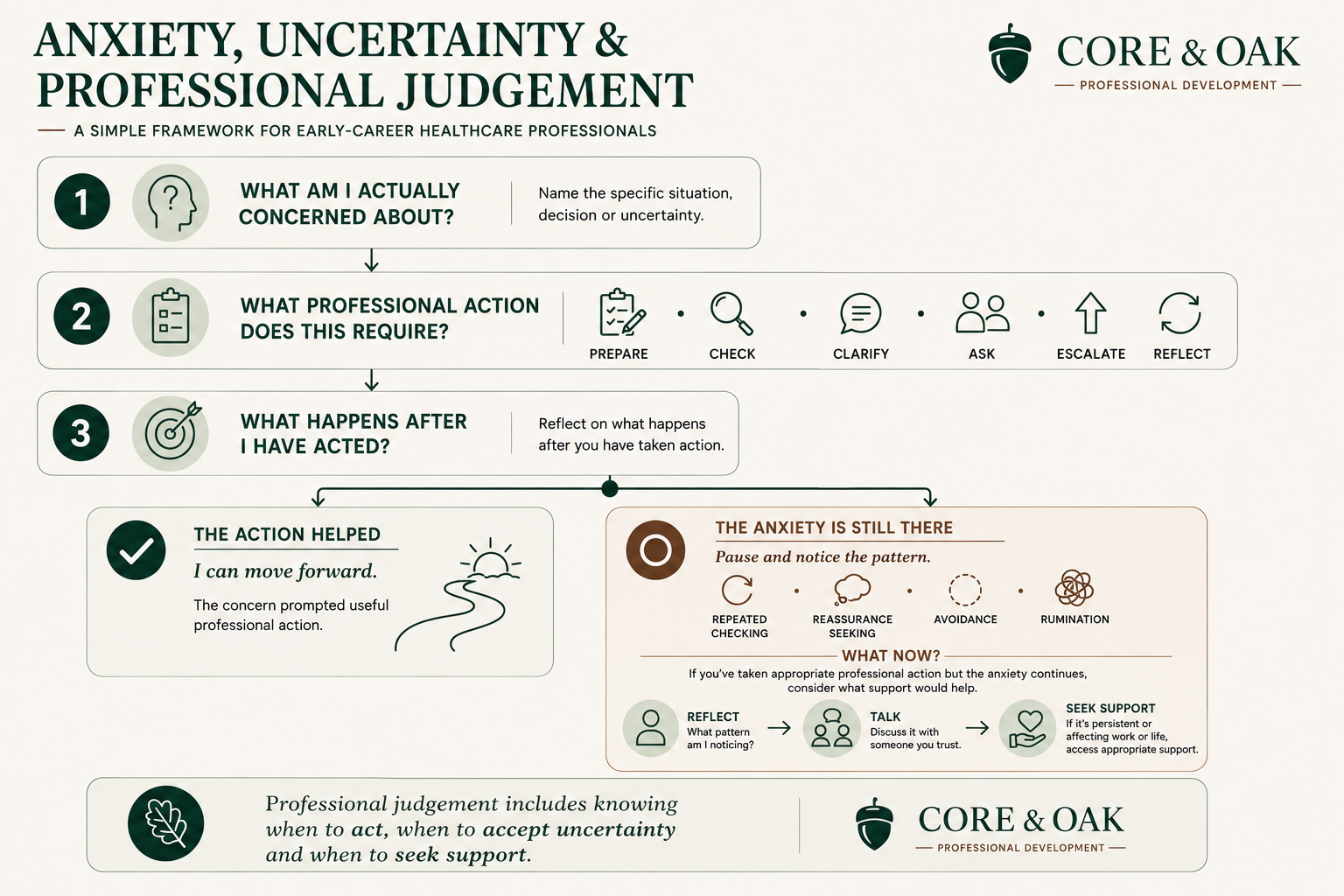
A practical way to respond when you feel anxious at work
When you notice anxiety around a clinical or professional situation, try working through three questions.
1. What am I actually concerned about?
Be specific.
Not:
“I’m worried I’ll get this wrong.”
But:
“I’m not confident that I have enough information to make this decision.”
or:
“The patient’s presentation has changed and I’m unsure whether they need review.”
Naming the concern makes it easier to respond to.
2. What professional action does this concern require?
Do you need to:
check something?
gather more information?
speak to the patient again?
review guidance?
ask a colleague?
escalate?
Or have you already taken the reasonable steps available to you?
3. What happens after I have acted?
This is often revealing.
If appropriate action allows you to move on, the concern may have been doing something useful.
If you continue repeatedly checking, seeking reassurance or replaying the situation despite having acted appropriately, it may be worth noticing that pattern.
The goal is not to analyse every anxious thought.
It is to become better at distinguishing professional uncertainty that requires action from anxiety that simply demands more certainty.
Healthcare can rarely provide complete certainty.
Professional judgement develops partly through learning to work safely without it.
Sometimes the appropriate action is to involve someone else. If asking for support itself feels difficult, it can help to organise what you know, what you are uncertain about and what you need from the other person.
Confidence usually develops quietly
One of the difficulties with early professional practice is that progress can be hard to see while it is happening.
You may imagine confidence arriving as a point where you stop feeling nervous.
More often, the changes are smaller.
A situation that once occupied your thoughts all evening takes ten minutes to process.
You still ask your senior colleague, but your question is more focused.
You recognise earlier when something needs escalating.
You recover more quickly after making a mistake.
You stop interpreting every gap in your knowledge as evidence that you do not belong.
The uncertainty has not disappeared.
Your relationship with it has changed.
That is often what professional confidence looks like.
Reflection
Think about a recent situation at work that made you anxious.
What were you actually concerned about?
What did the feeling lead you to do?
Did your response help you practise more safely, or did the anxiety continue after you had taken reasonable action?
Over time, noticing that distinction can tell you a great deal about both your professional judgement and the support you need.
The Core & Oak Perspective
The goal of early professional development should not be to create practitioners who never feel uncertain.
Healthcare is too complex for that.
The goal is to develop practitioners who can recognise uncertainty, think clearly about what it means and respond appropriately.
Sometimes that means preparing more carefully.
Sometimes it means asking a question.
Sometimes it means escalating a concern.
Sometimes it means accepting that you have made a reasonable decision with the information available.
And sometimes it means recognising that anxiety itself, or the environment in which you are working needs attention.
Professional confidence is not the absence of uncertainty.
It is increasingly knowing what to do when uncertainty appears.
Your Next Step
If this article resonated with you, these resources may also help.
FREE RESOURCE
What to Say When You’re Unsure
A practical free guide to framing uncertainty, asking for support and escalating concerns without feeling that you are undermining your professional credibility.
RELATED ARTICLE
Confidence as a Newly Qualified Healthcare Professional: Safe Practice Without Certainty
If uncertainty about whether you are making the “right” decision is affecting your confidence, you may find this article useful. It explores how to make safe, proportionate decisions when complete certainty is not available.
CONTINUE YOUR DEVELOPMENT
Professional Communication in Everyday Healthcare
If you want to develop these skills more systematically, this self-paced CPD course explores how communication, professional judgement and confidence come together in everyday healthcare practice.
Across approximately 10 hours of learning, you’ll work through realistic situations involving uncertainty, difficult conversations, feedback, escalation and communicating under pressure.
10 hours CPD · Self-paced · Designed for early-career healthcare professionals
Continue exploring early practice
If uncertainty, confidence or the transition into professional practice are familiar themes, you may also find these useful:
How to Ask for Help Without Feeling Incompetent →
Learn how to organise your thinking and ask for support clearly when uncertainty means you need another person’s input.
Why Do New Healthcare Professionals Often Feel Like Imposters? →
Explore why increasing responsibility and awareness of complexity can sometimes make you feel less capable rather than more.
About the author
Dr Michael McCluskey is a Chartered Physiotherapist and Senior Fellow of the Higher Education Academy, with experience across clinical practice, healthcare education, programme leadership, assessment and curriculum development.
He founded Core & Oak to create evidence-informed professional development that makes the hidden expectations of healthcare practice clearer.
Learn more about Michael and Core & Oak
Professional education disclaimer
This article provides general professional education. It does not provide individual clinical, employment, legal, psychological or occupational-health advice.
Healthcare professionals should work within their scope of practice and follow the policies, escalation procedures and professional standards relevant to their role and organisation.
Anyone experiencing significant or persistent distress should seek appropriate individual support.
Editorial and evidence standards
Core & Oak content is developed using the following principles:
- content is written or reviewed by a suitably qualified professional;
- professional and regulatory sources are prioritised where relevant;
- research evidence is interpreted cautiously and within its limitations;
- practical guidance is distinguished from individual clinical advice;
- uncertainty, contextual variation and system pressures are acknowledged;
- articles are periodically reviewed and updated;
- commercial links are included only where the resource is relevant to the reader’s identified need.
 Core & Oak